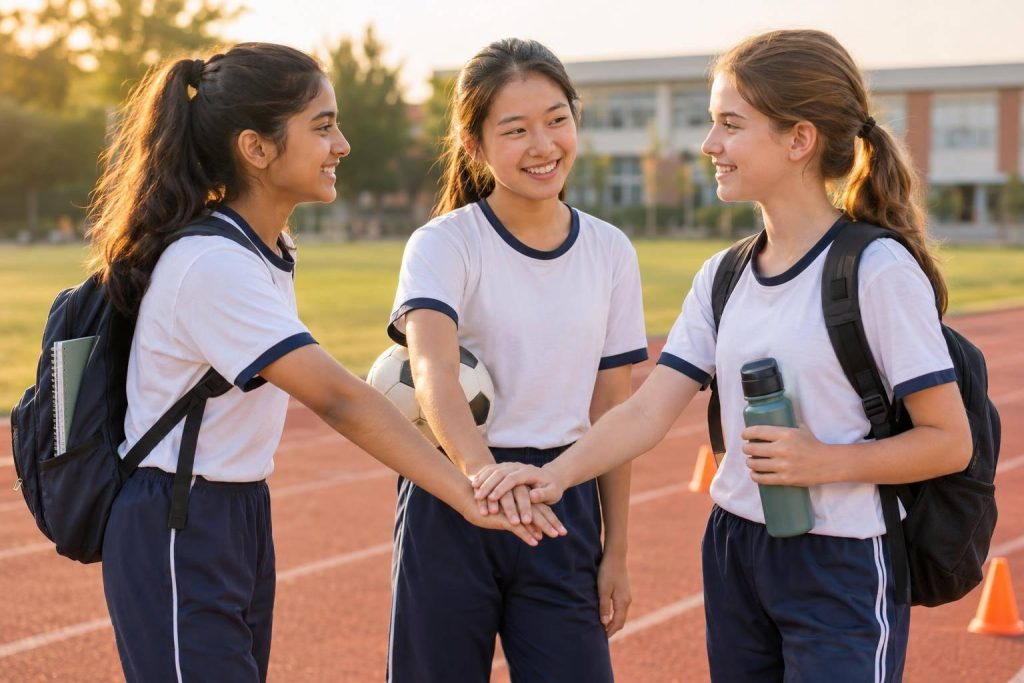
Sports help schoolgirls build skills for class, friendships and daily routines – not just matches. A simple starting point is a sport she enjoys, small practice goals and time for study and rest.
Regular participation, with supportive coaching, can help girls build:
- Confidence: Notice progress and speak up in class.
- Teamwork: Share tasks and listen to others.
- Leadership: Take responsibility and guide peers.
- Emotional resilience: Handle disappointment and try again.
- Stress management: Use movement breaks to ease study pressure.
- Self-discipline: Follow routines and finish schoolwork.
- Social connections: Make friends and ask for help.
For schoolgirls in India, games, yoga and house activities offer chances to practise these 7 skills. The aim is steady participation, not medals at the cost of sleep or studies. Sport can support mental health, but it does not replace professional care.
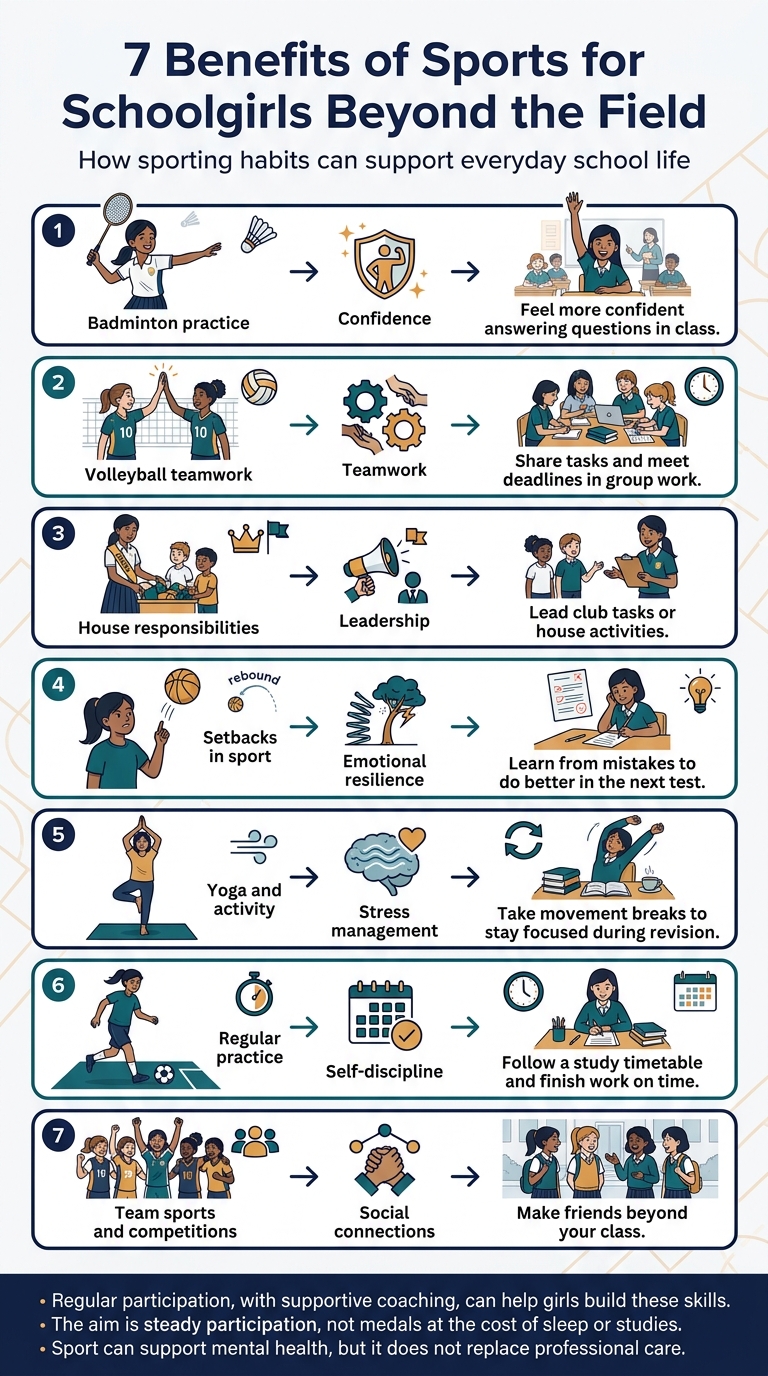
7 Benefits of Sports for Schoolgirls Beyond the Field
Benefits of girls playing sports
sbb-itb-9c83bad
How Sports Build Everyday Skills
Supportive coaching turns effort into self-belief. Girls then carry that mindset into class participation, homework and group work.
Regular, age-appropriate sport matters more than medals. Badminton, volleyball, yoga and athletics, along with inter-house activities, give girls space to practise regularly at school. These habits show up most clearly in daily school routines, which the next sections break down one by one.
Teachers and parents can encourage girls to reflect on how cooperation during play supports group projects. Staying calm during sporting setbacks can help girls handle setbacks in class more constructively.
Link reflection to action by treating daily revision like practice and using coaches and teachers to connect time management, responsibility and perseverance to study routines.
1. Confidence Through Progress
Transferable life skill
Confidence means trusting that you can improve – not expecting perfection.
How sports develop it
Repeated practice makes improvement visible through small goals, even after a loss.
Use feedback to identify one improvement and one next step. Learning to notice progress helps girls take part in class and approach project work with more confidence.
Everyday school application
The same habit of steady improvement helps girls speak up more easily in school, whether answering questions in class or presenting a project.
Practical takeaway
Point out one specific improvement, rather than focusing only on the score.
Parents and coaches can point to a successful serve or a determined effort in practice.
Ask her to describe what improved. This helps her build confidence on progress she can see, rather than encouraging words alone.
2. Teamwork Through Shared Goals
Transferable life skill
Girls learn to communicate clearly, respect different abilities and take responsibility for a goal they share.
How sports develop it
As girls gain confidence in their own abilities, sport teaches them how to work together.
Sport teaches girls to trust teammates, cooperate under pressure and value the group result over individual performance.
Everyday school application
The same approach helps in school projects. Girls can assign roles based on each member’s strengths, set deadlines and listen to one another’s ideas. When disagreements arise, respectful discussion keeps the group on task.
Practical takeaway
Agree on roles and deadlines early, and hold one another accountable.
3. Leadership Through Responsibility
Transferable life skill
Leadership does not need a captain’s title. It means encouraging others, making decisions, owning mistakes and setting an example through responsible behaviour.
How sports develop it
Learning to work as a team also helps girls learn to lead one. Sports offer regular chances to practise this skill. Rotating responsibilities during practice lets more girls guide an activity and take responsibility when things go wrong.
Everyday school application
These habits carry over into house activities, clubs and group tasks at school.
Dundlod Girls’ School’s four-house system gives girls regular chances to lead and support their peers through sports and other activities.
When organising a house activity, club event or group project, girls can take charge of one task and make the needed decisions.
Practical takeaway
Take on one responsibility at the next house activity, then pass it on.
4. Emotional Resilience After Setbacks
Transferable life skill
Resilience means dealing with disappointment and being willing to try again.
How sports develop it
A missed shot, a lost match or not being selected gives girls a chance to recover. With a coach’s guidance, they can reflect on the setback and choose one skill to practise next.
Everyday school application
After a low test score, girls can review errors, adjust preparation and ask a teacher for help. The aim is to fix what went wrong, not judge her ability.
Learning to reset after a setback can also help girls stay calm under everyday school pressure.
Practical takeaway
Give feelings space before talking about what to improve. Parents, teachers and coaches should listen first, then help her choose her next step. Asking for support is part of recovery.
5. Stress Management Through Activity
Transferable life skill
Stress management means planning activity breaks that help students reset without losing study time.
How sports develop it
Regular activity helps girls reset after setbacks and return to their next study block.
At Dundlod Girls’ School, activities such as yoga and aerobics help students stay mentally steady. House activities add routine and a steady reset during exam weeks.
Everyday school application
The same routine can fit into an exam revision timetable.
During exam prep, place a 30–45-minute activity break inside the revision timetable so it refreshes attention without cutting into study or sleep.
Practical takeaway
If stress affects sleep or studying, tell a parent, teacher or trusted adult and seek qualified mental health support. Sport can help with stress, but it cannot replace mental health care.
6. Self-Discipline Through Regular Practice
After learning to recover from setbacks, girls can build steady routines through regular practice.
Transferable life skill
Self-discipline means steady effort, not overtraining. Preparation helps girls arrive on time and finish what they start.
How sports develop it
Sports that follow fixed routines and rules build responsibility and habit. House activities also reward punctuality because each girl’s preparation affects the group.
These habits carry over to homework, revision and punctual attendance.
Everyday school application
Apply the same habits to a revision timetable: start on time and break the syllabus into smaller targets. Track finished topics and use the list to plan the next session.
Practical takeaway
Set one realistic target per study session. Avoid last-minute cramming and make time for rest.
7. Social Connections Through Participation
Transferable life skill
Sport helps girls do more than work as a team – it gives them a sense of belonging. Social confidence means including others and asking for help when needed. Taking part regularly gives girls chances to connect and support one another.
How sports develop it
Shared practice, house activities and inter-school competitions help girls make friends outside their usual circle, including with students from other age groups.
Everyday school application
Feeling part of a group can make it easier for girls to ask classmates for help in the classroom.
Welcome a new student through house activities, support a younger teammate or ask a sporting friend for help with a difficult subject.
Practical takeaway
Make inclusion part of team routines. Invite quieter girls into pre-game chats and after-practice check-ins, and encourage older students to help younger participants feel included.
Sports Skills in Everyday School Life
Habits built through sport can help with class participation, group work and daily school routines. Here’s how seven sporting habits translate into school-life skills.
Sporting experience Transferable skill School-life application Badminton practice Confidence Feel more confident answering questions in class. Volleyball teamwork Teamwork Share tasks and meet deadlines in group work. House responsibilities Leadership Lead club tasks or house activities. Setbacks in sport Emotional resilience Learn from mistakes to do better in the next test. Yoga and activity Stress management Take movement breaks to stay focused during revision. Regular practice Self-discipline Follow a study timetable and finish work on time. Team sports and competitions Social connections Make friends beyond your class.
Conclusion: Supporting Girls Beyond Sport
These seven gains show how sport builds life skills that go beyond scores and results.
At Dundlod Girls’ School, sports coaching, House leadership and pastoral care work together to support each girl’s overall development.
Choose a sport she enjoys. If training cuts into rest or study time, work with her coach and pastoral staff to adjust the routine, making room for both growth and balance.
FAQs
How can I help my daughter overcome sports anxiety?
Encourage your daughter to try one activity she enjoys. Talk about how she feels without putting pressure on her. Remind her that taking part can build confidence and teamwork over time.
If she finds it difficult to join in, speak to a matron or personal counsellor. They can help her ease into a group or house activity in a relaxed setting, without pressure. The school also offers professional counselling for continued support with stress and emotional concerns.
How can my daughter balance sports and exam preparation?
At Dundlod Girls’ School, students are encouraged to plan study routines that make room for both sports and academics. Staying organised and noticing when the workload feels too heavy can help them keep that balance.
If your daughter is struggling, encourage her to speak with her teachers or a trusted staff member early. They can help adjust her schedule before difficulties affect her wellbeing or exam preparation. Asking for support early is part of learning to be independent.
Can individual sports also build teamwork and leadership?
Yes. At Dundlod Girls’ School, individual sports build teamwork and leadership through shared responsibilities and support for teammates.
Through sports captaincy and fair play, girls learn to lead by example. They support teammates after setbacks and show commitment during training and school activities. These habits strengthen communication and cooperation, helping girls guide others, fulfil their responsibilities, and work towards group goals – not just personal performance.