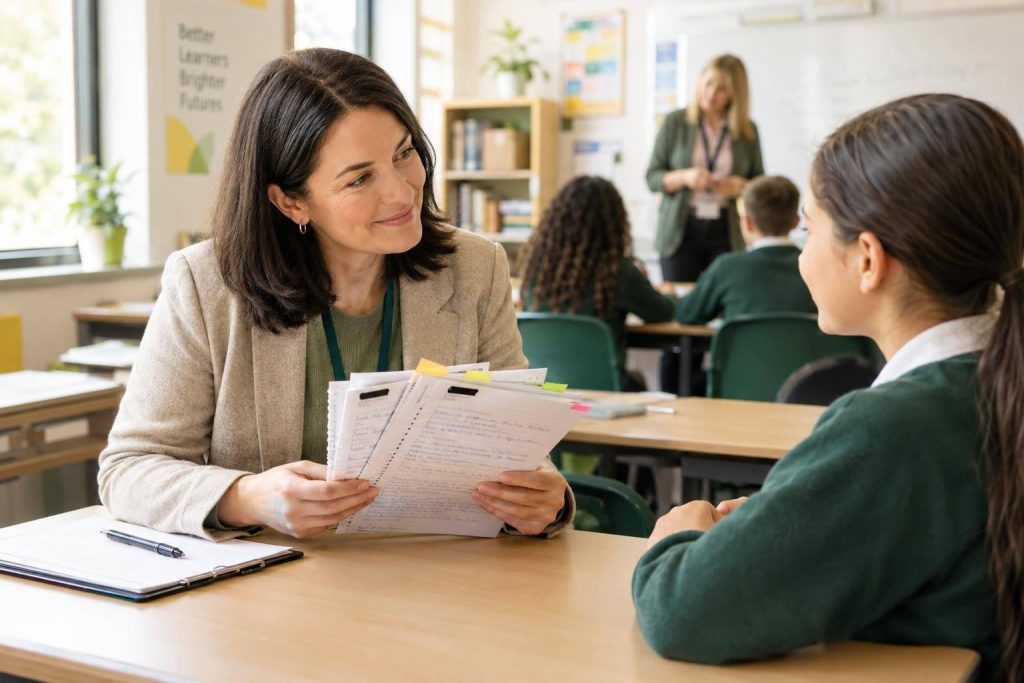
I judge teaching by what girls can explain and apply – not by the school’s buildings. During a visit to Dundlod Girls’ School, I would compare 3 sources: a regular lesson, teacher and student answers, and earlier and later student work.
Here’s what I would check:
- Teaching: Clear explanations, questions that test reasoning, participation across the class and calm responses to mistakes.
- Support: Help that changes when girls struggle, extra challenge when they’re ready, and access to academic help after lessons for boarders.
- Progress: Work that shows girls using feedback and applying what they’ve learnt – not just copying corrections.
I would ask permission before speaking with girls and request anonymised work samples. My rule: <u>keep observations separate from claims</u>, mark gaps as not observed, and look for the same teaching habits across lessons before forming a judgement.
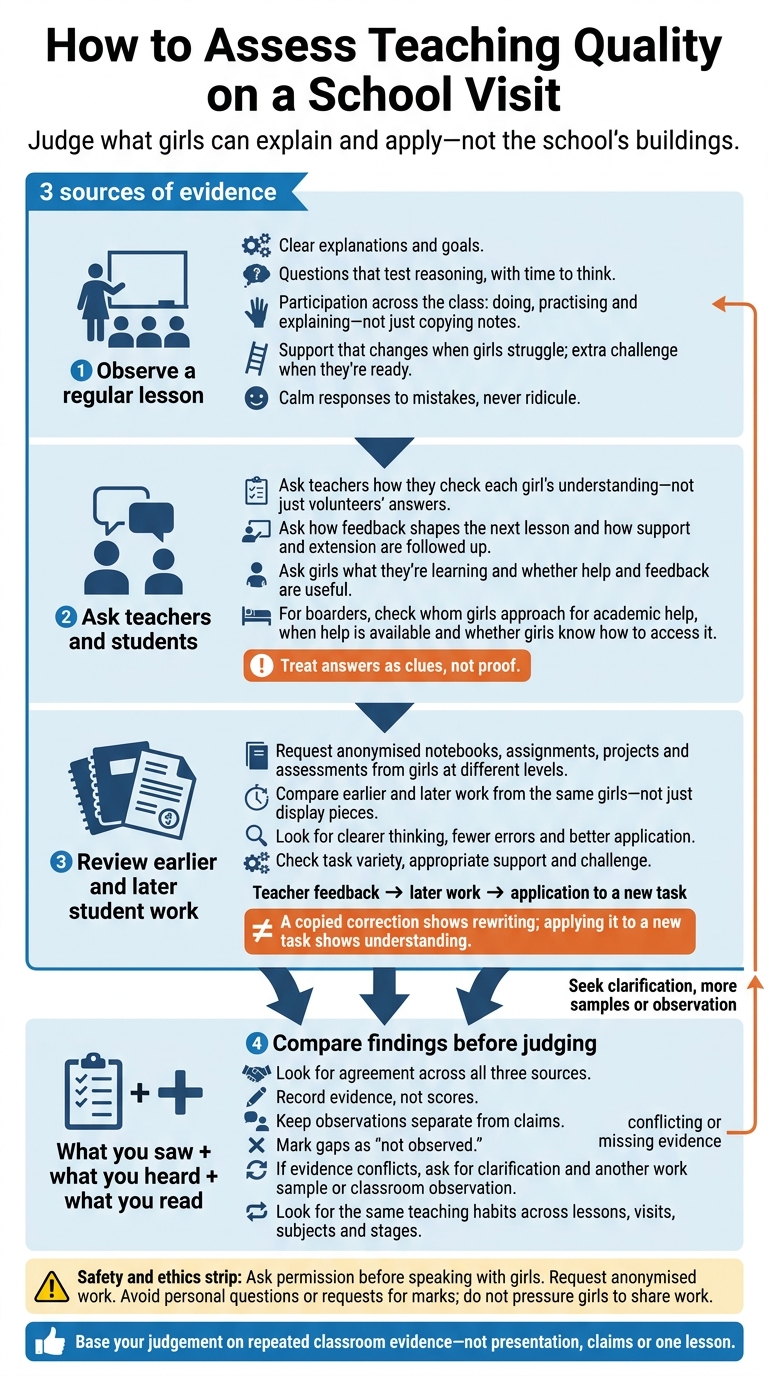
How to Assess Teaching Quality on a School Visit
Evaluating Teaching Effectiveness
sbb-itb-9c83bad
2. Observe Teaching and Student Learning
Use your observation sheet to check for clear explanations, active participation and support that changes when girls need help.
Check Explanations and Questions
Look for explanations and questions that help girls express ideas in their own words, rather than repeat memorised answers. Good questions give girls time to think and ask them to explain their reasoning.
Look for Participation and Respect
Watch whether girls are doing, practising and explaining tasks – not just copying notes or listening passively. Check that different girls get turns to speak. Mistakes should receive calm correction, never ridicule.
Check support when girls struggle
When a girl gets stuck, notice how the teacher responds. Does the teacher change the explanation or offer guidance suited to her needs?
| Evidence of effective practice | Warning signs requiring follow-up |
|---|---|
| Girls explain their thinking in their own words and answer follow-up questions. | Correct answers are accepted without checking girls’ reasoning. |
| Girls take part by doing, practising and explaining. | Most girls only copy notes or listen passively. |
| The teacher adjusts support when girls struggle and offers personalised guidance. | The teacher repeats the same explanation even when girls remain confused. |
| Mistakes are handled calmly and treated as part of learning. | Errors are met with ridicule, impatience or dismissal. |
Use what you observe to plan the questions you ask teachers and students next.
3. Ask Teachers and Students About Learning
Use your observation notes to check whether the teacher’s account matches what you saw.
Ask How Teachers Check Understanding
Keep questions brief. Ask what girls should be able to explain by the end of the lesson and how the teacher checks each girl’s understanding, rather than relying on volunteers’ answers. Find out how the teacher follows up on extra support and extension work.
Ask how feedback shapes the next lesson. Request recent work that shows how a teacher’s feedback helped a girl improve. For CBSE classes, ask how tasks develop reasoning and problem-solving rather than memorised answers.
Ask Students About Feedback and Help
Seek permission before speaking with girls. Avoid personal questions or requests for marks. Ask what they’re learning now, whether help is prompt and clear, and whether feedback helps them improve. Invite them to show teacher feedback they found useful, but don’t pressure them to share their work.
If you’re considering boarding, ask how girls get academic help outside lessons: whom they approach, when help is available, and how subject teachers coordinate support. Check whether girls know how to access that help, rather than relying only on an adult’s description.
Treat their answers as clues, not proof. Check accounts of application-based learning against tasks in notebooks or lab reports. Look for work samples that show how girls have used feedback. Let these answers guide which work samples you inspect next.
4. Review Student Work for Progress
Use the work itself to check whether feedback and support have helped girls improve. Review anonymised notebooks, assignments, projects and assessments from girls at different levels. Compare earlier and later work from the same girls – not just polished pieces selected for display. Read this alongside classroom observations and teacher comments. Look for clearer thinking, fewer errors and better application in later work.
Check Whether Feedback Leads to Improvement
Check whether each task makes clear what the girl was meant to learn. Read the teacher’s comments: do they identify a strength or explain what needs to change? Ticks and marks alone don’t show whether misunderstandings were corrected.
Then follow the feedback into later work. Does the girl explain her reasoning more clearly or apply the correction to a different task without help? A copied correction shows only that she rewrote the answer. Using it in a new task shows understanding.
Review Task Variety and Challenge
Next, look at the type of work set. Check for a balance of routine practice, written explanations, diagrams, practical work and projects that build on the concepts taught. Projects should show both subject understanding and practical application.
Across levels, check that girls receive support where needed and more challenging work when they’re ready. Ask how teachers keep marking and expectations consistent across sections.
5. Conclusion: Compare Findings with a Checklist
Bring together what you saw, heard and read to form a judgement. Compare your lesson notes, teacher and student answers, and work samples. Look for agreement across all three sources – not just a confident answer.
Use the checklist to compare classroom observations, conversations and student work. Record evidence, not scores.
| Check | Visit / lesson | Evidence seen | Notes |
|---|---|---|---|
| ☐ Explanations | Clear explanations and goals | ||
| ☐ Questioning | Questions probe understanding and reasoning | ||
| ☐ Participation | Girls across the class contribute | ||
| ☐ Assessment | Teaching changes after checking understanding | ||
| ☐ Feedback | Guidance students can act on | ||
| ☐ Support for different needs | Support and challenge are routine | ||
| ☐ Classroom climate | Respect for questions and mistakes | ||
| ☐ Student work | Tasks and progress match observations |
Judge by Repeated Practice
Apply the same criteria across visits, subjects and stages. Give more weight to everyday teaching you see repeatedly than to a single demonstration lesson. Keep staff claims separate from what you observe directly.
Mark gaps as not observed. When evidence conflicts, ask for clarification and another work sample or classroom observation. Be clear about what you have verified and what still needs checking. Base your judgement on repeated classroom evidence, not presentation, claims or one lesson.
FAQs
How can I tell if a lesson is rehearsed?
Watch whether classroom interaction feels natural or scripted. Look for spontaneous student participation, genuine questions and constructive feedback, rather than rote responses. Stiff contributions or predictable exchanges may point to an over-rehearsed lesson.
Notice how the teacher responds to unexpected questions and adjusts to each student’s learning needs. These moments can give you a clearer view of everyday teaching, rather than a rehearsed performance.
What if I cannot observe a regular class?
You can still assess teaching quality and the school’s culture. Ask to see student work and academic materials to learn how teachers track progress and spot learning gaps. Meet the academic coordinator to discuss assessments and support for students with different learning needs.
Visit the library and laboratories, too. Review the parent handbook and communication calendar to see how the school keeps families informed and supports student development.
Can strong exam results alone prove teaching quality?
No. Strong exam results can point to a solid academic base, but they don’t tell the whole story about teaching quality.
During a school visit, look beyond board results. Pay attention to the classroom atmosphere, how students take part in lessons and how teachers spot learning gaps. Also consider teachers’ subject knowledge, how they support different learning needs and how they communicate with parents about each child’s overall development.