
Choose Class 11–12 subjects based on interests, strengths and course entry requirements – not a stream’s reputation. Start with Class 9–10 marks and teacher feedback, then shortlist 2 subject combinations with a workload the student can sustain.
Quick Comparison
| Stream | Main subjects | Typical study demands | Common study routes | What to check |
|---|---|---|---|---|
| Science | Physics, Chemistry and Mathematics (PCM), Biology (PCB), or both (PCMB) | Numerical practice, theory and lab work; PCMB adds more work | Engineering, medicine and life sciences | Required subjects and entrance rules for each course |
| Commerce | Accountancy, Business Studies and usually Economics, with or without Mathematics | Accounts practice, calculations and case-based answers | CA, CS, management, finance and economics | Whether the course accepts or requires Mathematics or Applied Mathematics |
| Humanities | Combinations of History, Political Science, Geography, Psychology, Economics and other subjects | Reading, analysis, structured writing and projects | Law, journalism, social sciences and design | School subject combinations and college entry requirements |
No stream guarantees every career option. Some courses accept students from several streams; others require specific Class 12 subjects. Changing direction later may mean taking extra subjects.
Dundlod Girls’ School offers all 3 streams. Before submitting a preference, confirm its current subject combinations, eligibility criteria and any admission-test requirements, and discuss the shortlist with a parent, teacher or counsellor.
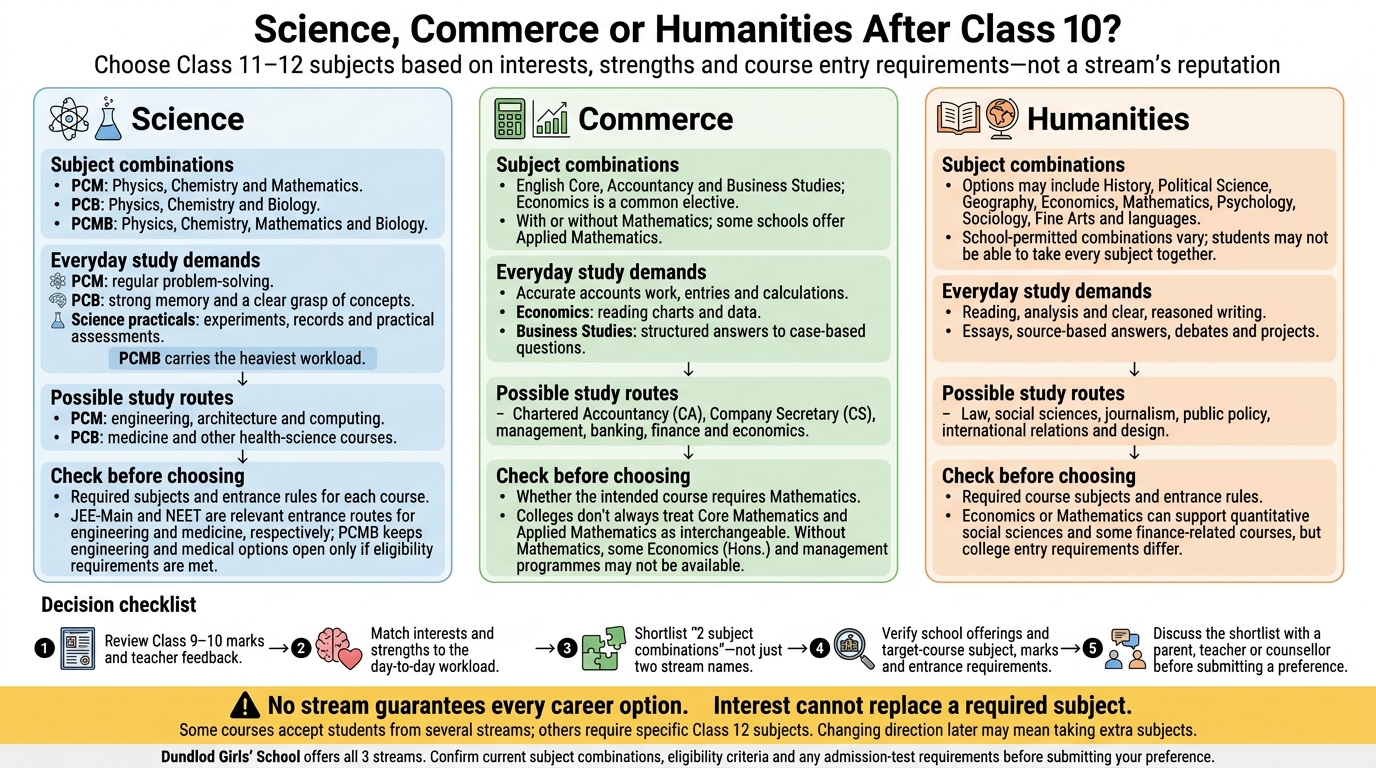
Science, Commerce or Humanities After Class 10?
1. Science
Subjects and combinations
Choose PCM (Physics, Chemistry and Mathematics), PCB (Physics, Chemistry and Biology) or PCMB (all four). Depending on your school, electives may include Computer Science, Informatics Practices, Artificial Intelligence or Biotechnology.
Workload
PCM calls for regular problem-solving, while PCB needs a strong memory and a clear grasp of concepts. PCMB carries the heaviest workload. Lab work also means experiments, records and practical assessments.
Choose PCMB only if you can keep up with the extra work – not just to keep more options open. Science suits students who are comfortable with steady practice and a heavier timetable.
Where Science can lead
PCM can lead to engineering, architecture and computing. PCB can lead to medicine and other health-science courses. JEE-Main and NEET are relevant entrance routes for engineering and medicine, respectively. Check the required subjects and entrance rules for each course.
Eligibility and flexibility
Science admission rules differ across schools. Before enrolling, check your school’s admission criteria and whether you need to take an aptitude test.
PCMB keeps both engineering and medical options open, as long as you meet the eligibility requirements. Check these requirements against your marks, interests and target course when deciding whether Science is right for you.
sbb-itb-9c83bad
2. Commerce
Subjects and combinations
Commerce suits students who want a finance-linked study path and are comfortable practising accounts regularly.
The usual subjects are English Core, Accountancy and Business Studies, with Economics as a common elective. Many schools also allow Mathematics or Applied Mathematics. Some offer Informatics Practices, Computer Science or AI.
Academic demands
Commerce calls for accurate accounts work and well-structured theory answers. In Accountancy, you’ll need regular practice with entries and calculations. Economics involves reading charts and data, while Business Studies requires structured answers to case-based questions.
Further study routes
Commerce prepares you for Chartered Accountancy (CA), Company Secretary (CS), management, banking, finance and economics. Business Studies also supports entrepreneurship. Taking Mathematics alongside Informatics Practices or AI can help prepare you for business analytics. Admission criteria differ by course and university.
Eligibility and flexibility
Without Mathematics, some Economics (Hons.) and management programmes won’t be open to you. Colleges don’t always treat Core Mathematics and Applied Mathematics as interchangeable. Check which subject your shortlisted Economics, management or B.Com. (Hons.) programme requires or accepts.
If you prefer reading, writing and public issues to accounts, compare Commerce with Humanities next.
3. Humanities
Subjects and combinations
Humanities may include History, Political Science, Geography, Economics, Mathematics, Psychology, Sociology, Fine Arts and languages. Some schools require English Core, History and Political Science, while electives vary by school. Check which combinations your school offers – you may not be able to take every subject together.
Academic demands
Humanities involves plenty of reading, analysis and clear, reasoned writing. Expect essays, source-based answers and class debates that ask you to build and support an argument. Following current affairs helps you connect classroom concepts with issues in everyday life.
Higher-study pathways
Humanities can lead to law, social sciences, journalism, public policy, international relations and design. Political Science helps you understand institutions and law. Languages build communication skills, while Fine Arts can prepare you for design-related study.
Eligibility and flexibility
Economics or Mathematics can support quantitative social sciences and some finance-related courses, but college entry requirements differ. Before choosing, check your school’s permitted subject combinations, the marks you’ll need and any aptitude test requirements.
Next, compare all three streams by workload, subject options and entry requirements.
How to Choose the Right Stream After Class 10th?🔥| Watch This Before Choosing | Prashant Kirad
Compare Workload, Study Options and Entry Requirements
Compare subject combinations, not just stream labels. The table covers typical options, but your choices depend on the combinations your school offers. It also compares workload, required subjects and overlap between higher-study options.
| Stream or combination | Typical Class 11–12 subjects | Main academic strengths required | Common higher-study directions | Subjects or eligibility conditions to verify | Workload and flexibility considerations |
|---|---|---|---|---|---|
| PCM | Physics, Chemistry, Mathematics, English; optional Computer Science | Numerical reasoning and problem-solving | Engineering, architecture, data science | Mathematics and other required subjects; relevant entrance rules | Regular numerical practice alongside science practicals |
| PCB | Physics, Chemistry, Biology, English; optional Biotechnology | Observation, recall and scientific understanding | Medicine, pharmacy, life sciences | Biology and applicable entrance requirements | Detailed theory, diagrams and laboratory work |
| PCMB | Physics, Chemistry, Mathematics, Biology, English | Numerical and biological reasoning; time management | Biotechnology, biomedical engineering | Separate eligibility rules for each intended course | Mathematics practice alongside Biology study and science practicals |
| Commerce with Mathematics | Accountancy, Business Studies, Economics, Mathematics, English | Calculation, logical reasoning and business analysis | Accountancy, finance, economics | Mathematics requirements for specific economics and finance degrees | Regular accounting and Mathematics practice, plus projects |
| Commerce without Mathematics | Accountancy, Business Studies, Economics, English; optional Informatics Practices | Numerical accuracy, organisation and applied understanding | Accountancy, management, marketing, hospitality | Whether the intended course requires Mathematics | Calculations are still part of the workload; some economics and finance degrees may require Mathematics |
| Humanities: typical combinations | History, Political Science and Sociology; or Geography, Economics and Mathematics | Critical thinking, writing and empathy; quantitative skills where relevant | Law, journalism, social sciences | Required course subjects and entrance rules | Reading, extended answers and projects; demands vary with electives |
Academic demands. Think about the work you can keep up with: lab work, calculations, accounts or long answers. Choose PCMB only if you can handle both Mathematics and Biology – not simply to keep your options open.
Higher-study pathways. Several courses accept students from different streams. Admission still depends on each course’s subject requirements and entrance rules.
Eligibility and flexibility. Match your interests and strengths with the combinations your school offers. Before confirming your choice, check the board syllabus and the subject requirements for your intended courses.
Pros and Cons: Which Stream Fits You?
Choose subjects that suit you – not prestige, stereotypes or an ‘easy’ label. Weigh the day-to-day study demands against the subjects your target courses require.
| Stream | Advantages | Limitations and trade-offs | Best fit |
|---|---|---|---|
| Science | Builds scientific reasoning for STEM routes. | Requires regular problem-solving and practical work; PCMB adds to the workload. | Students who enjoy hands-on experiments and daily problem-solving. |
| Commerce | Builds an understanding of business, accounts and finance. | Accountancy requires accuracy; some courses may require Mathematics. | Students comfortable with numbers and business logic. |
| Humanities | Builds analysis and communication skills. | Involves plenty of reading and structured writing. | Students who enjoy reading, analysis and structured writing. |
Use these trade-offs to shortlist streams before finalising your Class 11 subjects. Your Class 9–10 results and teacher feedback can help you spot consistent strengths. Then check the subjects, marks and entrance rules for your target courses. Interest cannot replace a required subject.
Conclusion: Shortlist and Confirm Your Choice
After comparing the three streams, shortlist two subject combinations – not just two stream names. Compare the subjects, workload and course requirements against your interests and strengths, rather than following your friends’ choices.
Discuss your two realistic options with your parents and a teacher or counsellor. Ask which workload you can handle through Classes 11–12. Before submitting your preference form to Dundlod Girls’ School, confirm the exact subject combinations on offer, current eligibility criteria and any admission-test requirements.
Check course rules before finalising your preference at Dundlod Girls’ School, especially if you’re counting on changing direction later. Overlapping pathways don’t guarantee a switch: some courses require specific Class 12 subjects. Changing later may mean taking extra subjects or gaining additional qualifications.
FAQs
How do I choose a stream if I’m unsure about my career?
Start with your interests and academic strengths. Look through the core and optional subjects in Science, Commerce and Humanities (Arts) to see which ones you’d enjoy studying.
Career paths often overlap, so choose a stream that leaves room for your main interests. Ask your teachers to help you review your performance and select subjects that support your long-term goals without overloading your schedule.
What if my interests and marks suggest different streams?
Choose subjects where your interests, marks and long-term goals overlap, rather than relying on interests or marks alone. Think about your academic and career plans, and which subjects you can stay committed to through Classes 11–12.
Talk to teachers and academic coordinators about your strengths and the prerequisites for courses you may want to pursue. Many career paths allow flexibility, but each course may have specific entry requirements. Aim for a balance between what keeps you motivated and the subject demands you can meet.
Can I change my stream after starting Class 11?
Whether you can change your stream after starting Class 11 depends on your school’s rules and course requirements. Speak to your school’s academic coordinator or administration to confirm the process, deadlines and eligibility criteria.
When choosing your stream, weigh your interests, strengths and long-term career goals. Before switching, check that your new stream meets the entry requirements for the courses you want to pursue later.