My advice: start with one school responsibility, not a title. For girls in Classes II–XII, I suggest choosing a task you enjoy, agreeing on it with a teacher and fitting it around your studies.
Here are 8 ways to practise leadership:
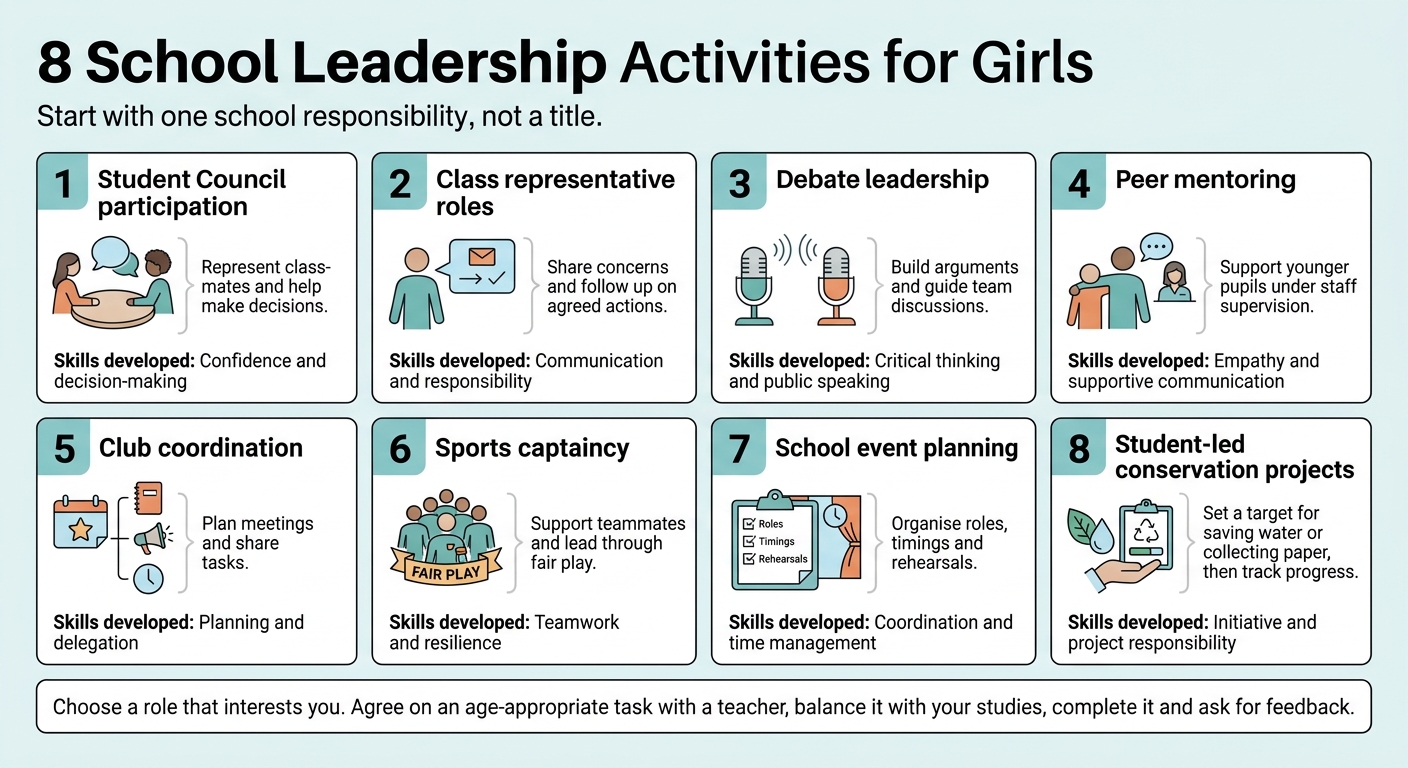
- Student council participation: Represent classmates and help make decisions.
- Class representative roles: Share concerns and follow up on agreed actions.
- Debate leadership: Build arguments and guide team discussions.
- Peer mentoring: Support younger pupils under staff supervision.
- Club coordination: Plan meetings and share tasks.
- Sports captaincy: Support teammates and lead through fair play.
- School event planning: Organise roles, timings and rehearsals.
- Student-led conservation projects: Set a target for saving water or collecting paper, then track progress.
I recommend keeping your first step small and clear: <u>agree on one task, complete it and ask for feedback</u>. That gives you a way to practise confidence, communication, teamwork and responsibility.
8 School Leadership Activities for Girls
Choose a Responsibility That Suits You
Pick a role that interests you and meets a real need, whether in sports, art, music or a literary club. Match the task to your class level and confidence, and check that you can balance it with your studies. Speak to a teacher before committing.
Leadership isn’t about being the loudest or most popular person. It takes listening, respect and follow-through, backed by empathy, discipline and dependable action.
Once you’ve identified a suitable role, look at how student council participation works.
sbb-itb-9c83bad
1. Student Council Participation
Student Responsibilities
The four-house system and student house council give girls a chance to practise leadership, represent their classmates and speak up about shared concerns.
How to Get Involved
Look out for the annual Student Council (Chhatra Parishad) formation in early April, when student leaders are chosen.
Skills Practised
Council discussions help girls practise active listening and decision-making. Assemblies and speeches build confidence and help them communicate clearly and respectfully.
For a day-to-day leadership role, the next section looks at class representative duties.
2. Class Representative Roles
Student Responsibilities
A class representative links classmates with teachers and school authorities. Speak to classmates before sharing their concerns, and keep topic-wise notes of issues and agreed actions.
How to Get Involved
Ask your class teacher if you can volunteer. Check what duties you’ll handle and how to bring concerns to teachers or school authorities. You’ll need to speak for the whole class, not just your friends.
Skills Practised
Giving short, clear updates builds communication. Keeping notes develops organisation, while following through builds reliability. When classmates disagree, listen to both sides, find their shared concern and suggest a solution instead of taking sides. That’s hands-on practice in problem-solving.
If you enjoy speaking up, the next role puts that skill to work in debate leadership.
3. Debate Leadership
Student Responsibilities
Research the motion and prepare arguments for both sides. Give each team member a clear speaking role, and keep discussions respectful and on topic.
How to Get Involved
Begin with a classroom discussion. Then join the literary and debating society, or take part in inter-house debates and speech competitions. Model United Nations-style discussions also help build confidence and leadership.
Skills Practised
Leading a debate develops critical thinking, active listening, persuasion and decision-making.
4. Peer Mentoring
Student Responsibilities
Help younger pupils organise their studies and settle into school routines. Offer patient guidance and keep staff informed of concerns. Refer serious academic, wellbeing or safety concerns to a teacher or pastoral staff member.
How to Get Involved
Ask about peer-support opportunities through the House System. Complete school-approved training before you begin mentoring, and work under teacher or pastoral staff supervision.
Skills Practised
Peer mentoring builds empathy, patience, communication and responsibility as you listen, explain things clearly and seek adult support when needed.
If you enjoy guiding others one-to-one, the next role takes that leadership to a larger group.
5. Club Coordination
Club coordination takes leadership beyond one-to-one support and into managing a small team.
Student Responsibilities
Organise meetings or rehearsals for dance, music and academic clubs such as Science, Debate and Literature. Agree on meeting times with the supervising teacher, share duties fairly and maintain a short progress log.
How to Get Involved
Ask the activity teacher how to join an existing club and take on a coordination role. If no club covers your interest, suggest a teacher-supervised activity with a clear goal and meeting plan.
Skills Practised
Working around lessons builds planning and time management. Sharing duties develops delegation and teamwork, while tracking progress and reporting to your supervising teacher builds accountability.
If you also enjoy leading games and fitness activities, the next role focuses on leadership in sport.
6. Sports Captaincy
Sports captaincy gives girls a chance to lead through action, not just words.
Student Responsibilities
Work with staff to organise practice sessions, support teammates after setbacks, and set an example through fair play.
How to Get Involved
Attend coaching regularly, ask about trials, and carry out the duties your coach assigns.
Skills Practised
Supporting teammates builds communication, while making choices during play develops decision-making. Keeping commitments strengthens accountability, and dealing with competition pressure builds confidence, teamwork and perseverance.
If you enjoy organising people and schedules, the next role looks at leading behind the scenes at school events.
7. School Event Planning
For girls who enjoy working behind the scenes, school events offer a hands-on leadership role. They get to practise organisation and team coordination in a public setting.
Student Responsibilities
Work with a teacher to plan a cultural celebration, exhibition or performance. Help set the programme, assign stage roles and track rehearsals. Afterwards, review what worked and what did not.
Students can also coordinate committees, manage timings and keep the stage programme running to plan.
How to Get Involved
Ask your teacher about joining an organising committee through your school’s House system or a cultural club. Start with one task, such as helping to coordinate rehearsals, before taking on more responsibility.
Skills Practised
Assigning roles helps students practise coordination, teamwork and decision-making. Sharing duties clearly also builds communication, time management and responsibility.
8. Student-Led Conservation Projects
Student Responsibilities
Work with teachers and classmates to identify a campus need, then choose one project.
Options include waste segregation, recycling, water conservation, cleanliness or upcycling.
Give each student a clear role:
Waste monitors check bins, water ambassadors promote conservation, and upcycling coordinators manage reusable materials.
Set a measurable target and track progress in a logbook or digital sheet.
For paper collection, set a weekly target in kilograms and record the amount collected.
How to Get Involved
Join a conservation committee or suggest a project through the Student Council, House system or Art & Craft club. Before starting, get approval for the tasks, materials and supervision.
Skills Practised
Conservation projects build initiative and civic responsibility. Spotting a need develops initiative, while sharing duties builds teamwork. Tracking progress develops project management skills, and adjusting the plan strengthens problem-solving.
Each role helps students practise the core leadership skills listed below.
Leadership Skills at a Glance
Use this table to find an activity that builds the skill you want to work on.
| Leadership activity | Skills developed |
|---|---|
| Student Council participation | Confidence and decision-making |
| Class representative roles | Communication and responsibility |
| Debate leadership | Critical thinking and public speaking |
| Peer mentoring | Empathy and supportive communication |
| Club coordination | Planning and delegation |
| Sports captaincy | Teamwork and resilience |
| School event planning | Coordination and time management |
| Student-led conservation projects | Initiative and project responsibility |
Choose the role that matches your growth goal, then discuss the responsibility, support and study balance with a teacher or mentor. Leadership skills reinforce one another: empathy helps sports captains support teammates, and clear communication helps with event coordination.
Next, put these skills to work as you take your first leadership step.
Conclusion: Take Your First Leadership Step
From student council to conservation projects, leadership grows when you serve others and follow through on your commitments.
Start with one role. Agree on an age-appropriate responsibility with a teacher. Make sure you understand the task and what’s expected, then complete it. Reflect on what went well and what you could improve. Use your teacher’s feedback to guide your next step.
FAQs
How can shy girls start leading at school?
Shy girls can start with one activity they enjoy, such as a hobby club or sport, instead of trying everything at once. A matron or personal counsellor can help them join a group or house activity.
Taking part gives them a relaxed, low-pressure way to connect with peers and learn to work as a team. Over time, these interactions can build the confidence and communication skills they need for larger leadership roles.
How can I balance leadership duties with exams?
At Dundlod Girls’ School, balancing leadership duties with exams takes time management and self-awareness. Plan your study routine and stay organised so you can make time for both.
If your workload feels difficult to handle, talk to your teachers or a trusted staff member about your schedule. Being independent also means knowing when to ask for help. Seek support early, before difficulties affect your exam preparation or overall wellbeing.
How can I track my growth as a leader?
Track how your co-curricular leadership roles help you build confidence, decision-making, communication, teamwork and responsibility over time. Set small goals for each activity, whether it’s a debate, a club, sports captaincy or community service.
Take time to reflect on what you planned and led, how you worked with others and how you handled challenges. Ask staff for feedback and mentoring to help you do better next time.