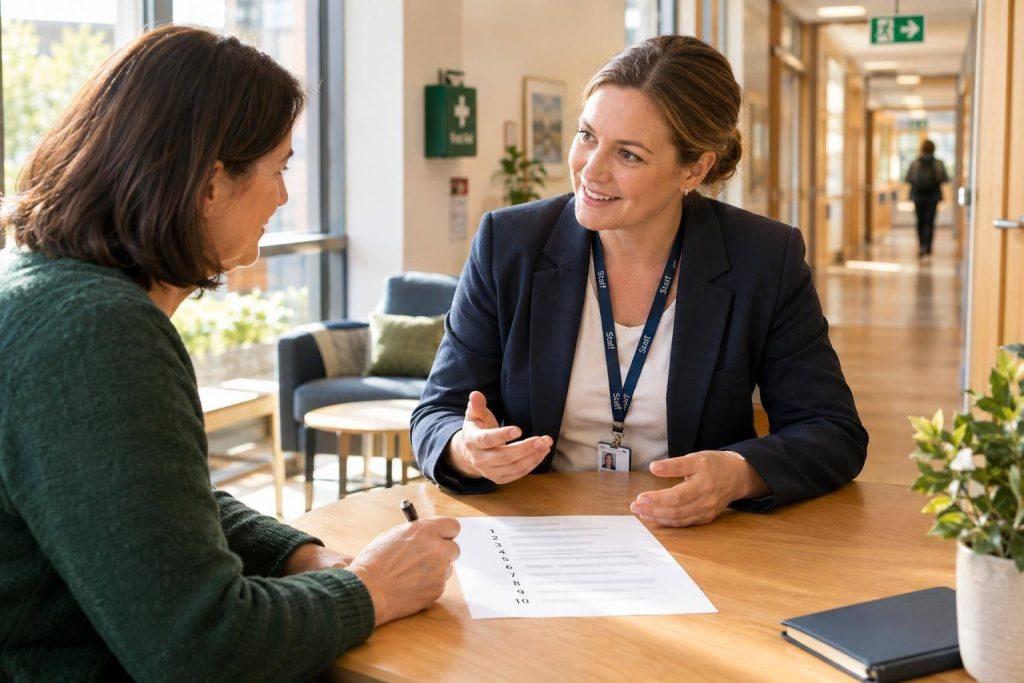
Before I choose a boarding school, I want proof of how it keeps children safe – not just gates and CCTV. I would check current records, meet the adults on duty and ask who would help my child at 2:00 a.m.
These 10 questions cover what I would check during a school visit:
- Entry and collection: Who checks visitors and approves who can collect my child?
- Boarding supervision: Who is on duty during evenings, nights and weekends?
- Staff checks: Have adults working with students completed background checks and safeguarding training?
- Adult–student boundaries: What rules cover private meetings, messages and access to dormitories?
- Bullying and online abuse: How does the school stop harm and check that it has ended?
- Private reporting: Can my child report a concern safely, including after lights-out?
- Medical and mental-health care: What qualified help is available, day or night?
- Emergencies: Who leads evacuations, checks headcounts and supports children who need help?
- Transport and trips: Who checks vehicles, activity risks, consent and supervision?
- Parent contact: When will the school tell me about an incident, and what happens if I cannot be reached?
I would also verify CBSE affiliation, where claimed, and request redacted records rather than other children’s private files. My rule: <u>get unresolved safety gaps, named responsibilities and deadlines in writing before enrolment</u> – then keep checking how the arrangements work for my child. A checklist is a starting point, not a safety guarantee.
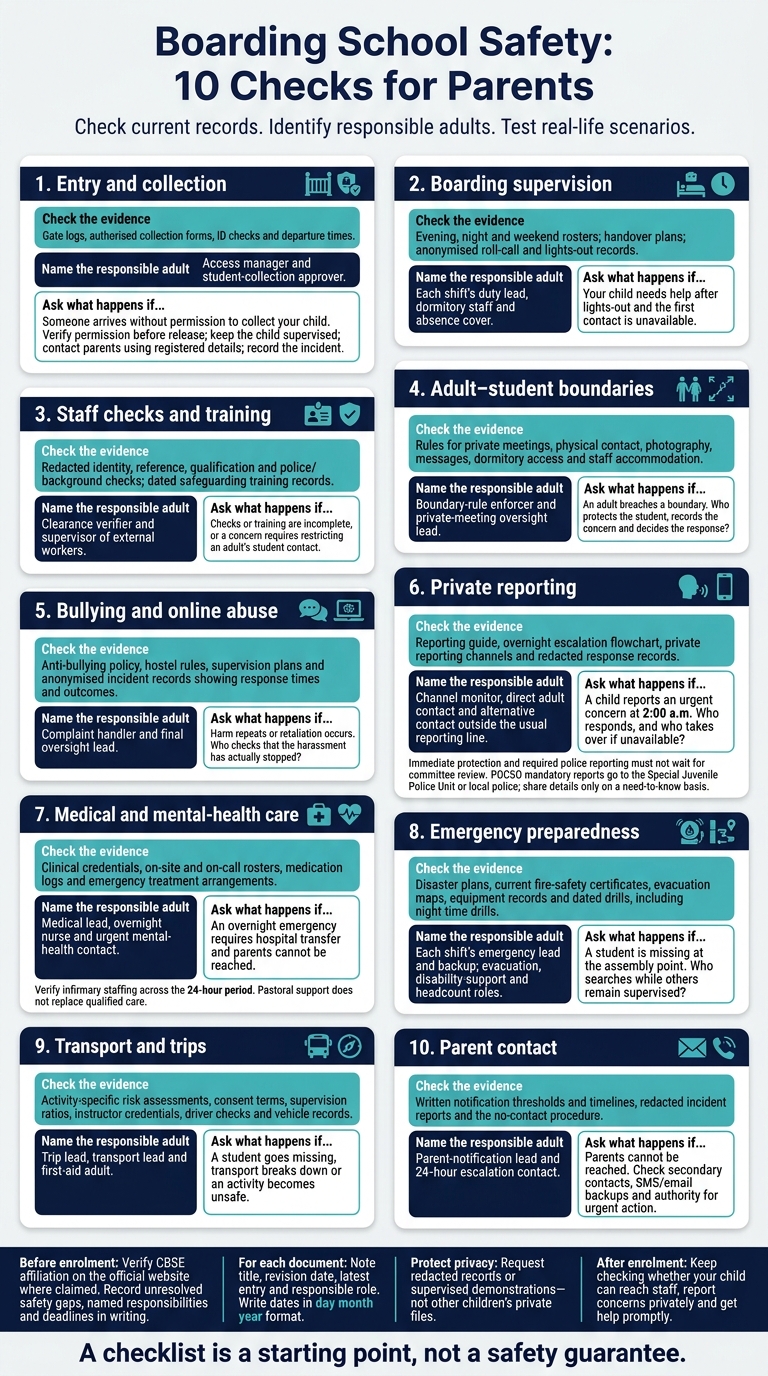
Boarding School Safety: 10 Checks for Parents
Before Your Visit: Request Records and Talk to Your Child
Before your visit, request current copies of the student and staff safety policy, medical care policy, bullying and harassment policy, and hostel rules.
Arrange to meet the Principal, hostel warden or matron, and residential staff. Ask who will handle your daughter’s concerns – and how you can reach them after hours.
Speak privately with your daughter about her age, comfort with language, disability or accessibility needs, health needs and homesickness. Share her needs with residential staff, then ask what support they can offer for accommodation, language and emotional care.
Verify CBSE affiliation on the official website. Ask how the campus and hostel meet CBSE and state safety rules.
Respect other children’s privacy when reviewing records. Ask for redacted copies or a supervised inspection of sensitive documents. Use these records and conversations to check the answers to the next 10 questions.
sbb-itb-9c83bad
1. How does the school control campus entry and student collection?
Records to Request
Ask for recent gate logs covering student pick-up times, badge procedures and authorised collection forms. Check whether staff record ID checks and departure times.
Review boundary inspection and CCTV maintenance records too. Confirm that cameras cover entrances and common areas – not bedrooms, toilets or changing areas.
Who Is Responsible
Once you’ve reviewed the records, ask who manages daily access and who approves student collection. How do staff check the collector’s government-issued ID against the authorised list before releasing the child?
Check that boundary fencing is intact, entrances are monitored and visitors cannot enter dormitories.
What Happens If
Ask what staff do when someone arrives without permission to collect a child. Request the written procedure for collection without permission. Staff should refuse to release the child until permissions are verified, keep the child supervised, contact you using your registered details and record the incident.
2. Who supervises boarders during evenings, nights and weekends?
Once you’ve checked entry controls, find out who is on site to supervise students after lights-out.
Records to Request
Ask for the residential supervision policy, evening and weekend rosters, and overnight handover plan. Request anonymised roll-call and lights-out check records too. These help confirm that checks are recorded, not just scheduled.
Who Is Responsible
Identify the duty lead for each shift. Ask how many matrons or wardens stay on site overnight, where they are stationed and who covers each dormitory. Check who provides cover during illness or leave, or when an assigned staff member is absent.
Ask how handovers are recorded when the assigned matron is absent and who covers the dormitory until the next shift. The staffing plan should make it clear who is accountable for every shift.
What Happens If
Ask how your daughter can reach the duty lead after lights-out, who she should contact if that person is unavailable and how she can get medical help overnight.
Check after-hours access too: can students reach staff quickly and leave safely in an emergency? Ask whether these routes are tested during drills.
3. What checks and safeguarding training do adults working with students complete?
Records to Request
After checking who supervises boarders, confirm who is cleared to work with them.
Ask to review redacted identity, reference, qualification and police/background-check records for staff, matrons, coaches, drivers, contractors and volunteers. Also request safeguarding induction and refresher-training records, including completion dates and topics covered. Keep all personal details redacted.
Who Is Responsible
Ask who verifies each check and records clearance before an adult starts work. For external workers, confirm who supervises them and how that supervision is logged. Check who oversees the safeguarding lead if a concern involves that person.
What Happens If
Ask how the school prevents unsupervised access to students when checks or training are incomplete, and who authorises those restrictions. Also confirm who can suspend an adult from student contact when someone reports a concern.
Once staff screening is clear, ask how the school sets rules for adult contact with students.
4. What rules govern adult–student contact?
Once adults have been screened, check the rules that govern their day-to-day contact with students.
Records to Request
Ask for the student and staff safety policy and staff code of conduct. Check their rules on private meetings, physical contact, photography, digital messages and access to boarding areas. The code should also cover behaviour that breaches safeguarding rules, even when it is not a criminal offence.
Ask whether students are ever allowed into staff accommodation and how the school enforces its rule.
Who Is Responsible
Ask who enforces these boundaries for staff, coaches, volunteers and visitors. Also check who monitors one-to-one counselling sessions and other private meetings.
What Happens If
Ask how the school records and reviews a boundary breach, who protects the student and who decides what action to take. Check when the school must report the matter to the authorities. The answers should help you judge how quickly the school acts when behaviour crosses a line.
5. How does the school prevent and address bullying, harassment, ragging and online abuse?
After checking adult contact rules, look at how the school handles harm between students. Prevention should be part of daily boarding supervision.
Records to Request
Ask for the anti-bullying policy, hostel rules, student orientation materials and hostel notice-board guidelines. Do the policy and hostel rules clearly address bullying, harassment and ragging? They should also explicitly define online abuse and harassment as misconduct.
Request supervision plans for high-risk areas, such as dormitories and common rooms. Ask for anonymised incident records that show response times and outcomes.
Who Is Responsible
Find out which matron, warden, housemaster or housemother handles complaints, and who has final oversight. Ask how staff distinguish ordinary conflict from bullying, particularly when behaviour is repeated or one student has more power than another.
What Happens If
Ask what immediate steps the school takes to protect students from retaliation. Check the consequences for repeated misconduct and whether counselling or follow-up meetings continue after a case closes.
Find out who checks that the harassment has stopped, rather than simply confirming that disciplinary action was taken.
Next, check how students can report concerns privately and quickly.
6. How can students report concerns safely and privately?
Records to Request
Ask for the school’s written reporting guide and overnight escalation flowchart. Check whether students can report through a counsellor, safeguarding contact or complaint committee, as well as a sealed box or monitored digital channel.
Confirm whether the school accepts anonymous reports. Request redacted records showing when reports were received, checked and acted on.
Who Is Responsible
Identify the adults who monitor each channel. Confirm how often they check it and who steps in during absences. Ask for both a direct adult contact and an alternative contact students can approach if someone in the usual reporting line is involved.
What Happens If
Ask staff to walk you through an urgent concern reported at 2:00 a.m. Who responds? Where can the student speak privately? Who takes over if the first contact is unavailable?
Check how students can contact parents urgently outside scheduled calling hours. Immediate protection and any required police reporting must not wait for a committee review.
Ask how staff explain POCSO reporting duties. Any report that triggers mandatory reporting must go to the Special Juvenile Police Unit or local police. Details must be shared only on a need-to-know basis.
Once the reporting routes are clear, ask who provides medical or counselling support after hours.
7. How can students get medical and mental-health support, day or night?
Records to Request
Once you’ve checked reporting routes, confirm whether the school can provide immediate care at any hour.
Request the doctor’s and nurses’ qualification and registration records, the counsellor’s credentials, and current duty rosters showing on-site hours and on-call availability. Check first-aid arrangements, medication storage and administration logs, and a redacted sample of the term-start health-check report. Ask who staffs the infirmary throughout the 24-hour period and who covers each shift.
Who Is Responsible
Identify the medical lead, overnight nurse and after-hours contact. Check who administers prescribed medicines, who decides on hospital referrals, and how matrons pass health concerns to clinical staff. Confirm the counsellor’s on-site hours and who students can contact for urgent mental-health support after hours.
What Happens If
Ask staff to walk you through an overnight emergency, from the infirmary’s response to hospital transfer. Verify ambulance access, hospital links and transfer time. Inspect the isolation room and check who supervises a student with an infectious illness.
Review the emergency consent policy. If parents cannot be reached, how does urgent treatment proceed? Who makes the decisions, and how are external treatment costs handled?
Then check how the school protects privacy during routine care and when students seek help with sensitive needs.
Student Access and Privacy
Ask how girls can privately access qualified help for menstrual-health care or counselling. Check where health records are stored and who can see them. Find out how staff explain confidentiality – and its limits – before counselling begins. Pastoral support must not replace qualified medical or mental-health care.
8. How does the school prepare for fires, disasters and other emergencies?
Once you’ve checked medical support, ask how the school plans for large-scale emergencies.
Records to Request
Ask to see disaster-response plans, current fire-safety certificates, safety audits, evacuation maps and assembly points. Check equipment-maintenance records and dated drill logs, including night-time drills. Ask how often drills take place and who records them.
Who Is Responsible
Find out who leads the emergency response on each shift, especially overnight, and who acts as backup. Ask for written staff duties covering evacuation, disability support, headcounts, transport and family contact. Confirm who makes decisions if the principal is off campus.
What Happens If
Ask staff to walk you through what happens if a student is missing at the assembly point. How do they identify who is missing, find her and keep the other students supervised?
Confirm when parents will be notified, both during and after an emergency. Ask staff to show you the dormitory evacuation route and assembly points in person.
Next, check how the school manages transport and off-campus safety.
9. What safety checks cover transport and off-campus activities?
Once you’ve checked campus safety, look at how the school manages trips beyond the gate.
Records to Request
Ask for activity-specific risk assessments, consent forms and student-to-staff ratios for each activity. Check instructors’ qualifications and the safety rules for swimming or horse riding, where offered. Does each trip require separate consent, or does a standing consent form cover it?
Review the transport provider’s records, driver background checks, vehicle documents, maintenance logs and seat-belt checks. Ask to see route plans and first-aid kit checklists, rather than relying on verbal assurances.
Who Is Responsible
Ask for the named trip lead and transport lead, along with the adult responsible for first aid. Confirm who checks departure permissions and records headcounts at every handover. Check how staff maintain supervision if an adult has to step away unexpectedly.
What Happens If
Ask staff to walk you through the written missing-student procedure. It should state who checks the register, leads the search, supervises the remaining students and contacts local authorities and parents. Confirm how soon each step must happen.
Also ask who has the authority to stop an unsafe activity or arrange replacement transport after a breakdown, and how the school informs families.
10. When and how will parents hear about incidents affecting their child?
Keeping children safe also means telling parents promptly when something goes wrong. After checking off-campus safety, ask how soon the school will contact you about an incident involving your child.
Records to Request
Ask for the school’s written notification thresholds and timelines for injuries, missing students, bullying and major emergencies. Request a redacted incident report, too, so you can see what staff recorded and what follow-up took place.
Who Is Responsible
Find out who contacts authorised parents or guardians during an incident and who serves as the 24-hour escalation contact. Confirm who may receive sensitive information about your child and how the school keeps contact details up to date.
Ask how families receive safety updates. Request a recent drill record and the parent notice sent afterwards.
Check what staff do if they cannot reach you straight away.
What Happens If
Ask staff to walk you through the no-contact procedure: how many calls they make, when they try secondary contacts and whether they use SMS or email as a backup. Clarify who authorises urgent action if parents cannot be reached in time.
If the school delays telling parents during a safeguarding or police matter, ask which rule requires the delay and when you can expect the next update.
Campus Visit Checklist: Records to Review
Use this checklist to check whether the school’s answers match its day-to-day practice.
- Access and supervision: Review redacted visitor and student-exit/collection logs, staff biometric entry/exit logs and overnight boarding rosters. Compare the written permission process with what you see at the gate.
- Safeguarding and reporting: Review safeguarding, adult–student contact, anti-bullying and complaint policies, along with staff screening and dated training records. Ask staff to show you a private reporting channel. Check who receives a concern if it involves the usual contact person.
- Health and emergencies: Review healthcare arrangements, term medical-check records, 24-hour infirmary cover and emergency treatment authority. Ask for fire and safety drill records, including dates and the scenario used in the latest drill.
- Activities and communication: Review transport and excursion safety checks, supervision arrangements and consent terms. Confirm whether a general authorisation covers permission for trips or camps.
For each document, note its title, revision date, latest entry and responsible role, along with what you reviewed and any unanswered questions. Write dates in day month year format. Ask for redacted records or system demonstrations rather than private files.
Conclusion: Check How Safety Works in Practice
After these checks, make sure current records match daily practice: reliable supervision, clear responsibility, private reporting and prompt action – not just promises on paper.
Record safety gaps in writing before enrolment. Ask the Principal or Hostel Warden to confirm each fix, who will handle it and the deadline. Get written answers to unresolved questions about medical care, supervision and parent notification.
After enrolment, check through regular calls whether your daughter can reach staff, report concerns privately and get help promptly. Follow up if her experience doesn’t match the school’s assurances. No checklist guarantees safety; keep checking how the arrangements work for her in daily routines, not just in policy papers.
FAQs
What safety red flags should stop me from enrolling my child?
Stop the enrolment process if there are serious gaps in child protection, fire safety, healthcare or supervision. Do not proceed without valid fire-safety records, written evacuation plans and proof of periodic safety drills.
Other red flags include:
- No written policies on staff qualifications or 24/7 overnight medical cover.
- No clear, confidential system for reporting bullying, abuse or other concerns.
- Safety records or policies that are unavailable, incomplete or unverified.
What if the school refuses to share safety records?
If the school refuses to share safety records, do not proceed with enrolment. Child protection, fire safety, healthcare and supervision are pass–fail checks – not areas for compromise.
Ask for building safety certifications that meet the National Building Code, valid fire safety certificates issued by the relevant authorities, and written safety policies for students and staff.
Missing or unclear documents point to a serious gap in protection for your daughter, whose safety must come first.
Where can I escalate an unresolved safeguarding complaint?
If a safeguarding complaint is still unresolved after you’ve spoken with the assigned pastoral staff or counsellors, treat it as urgent and contact the school administration immediately. If anyone is in immediate danger, seek emergency help at once.
During your assessment, ask for the school’s official complaint procedure and student-staff safety policy. Keep written responses and dated records so you can check whether the school is meeting its stated safeguarding commitments.