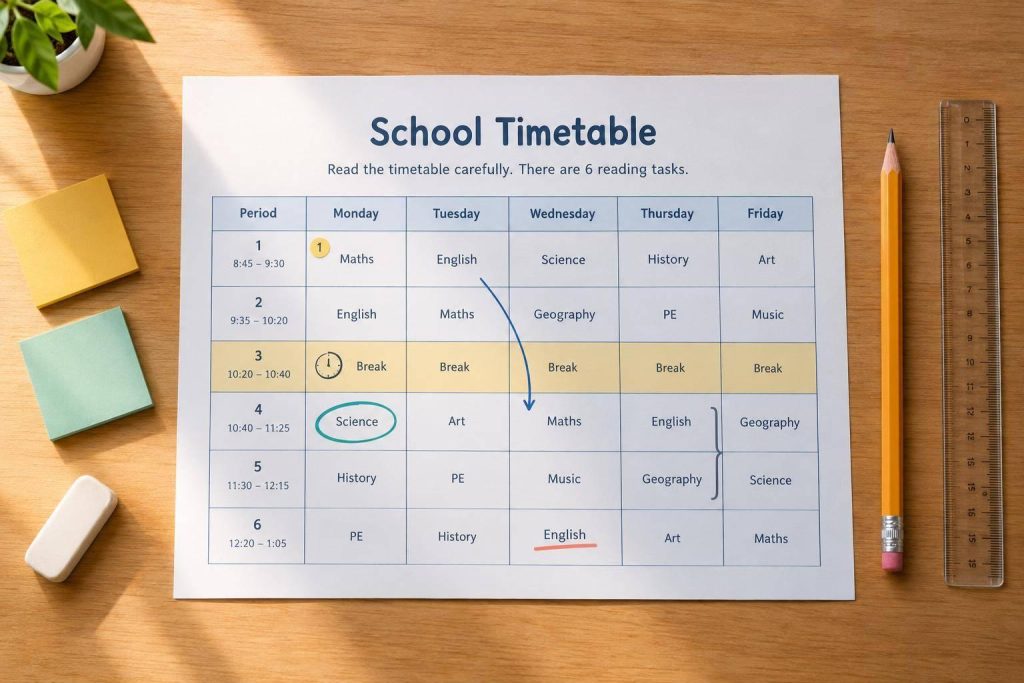
These six school timetable tasks help pupils in Classes III–V read lesson times, follow the school day and explain timetable changes. Start by checking the day heading, period row and lesson’s start and end times.
The tasks cover:
- Finding subjects and counting weekly lessons.
- Putting lessons in order for a given day.
- Reading break times and working out their length.
- Filling in missing entries using timetable clues.
- Comparing timetable changes, including moved and replaced subjects.
- Writing complete sentences about times, lesson counts and packing school materials.
Printing notes and an answer key support classroom practice, homework and checking. Assembly, short break and lunch are listed separately from lesson periods.
Teaching and Printing Notes
Use these notes to print and teach the six tasks efficiently.
The tasks suit Classes III–V. Match support to each pupil’s reading level. Before pupils read the timetable below, check that they recognise the days of the week and subject names such as English, Hindi, Mathematics, General Science and Social Studies.
Check that pupils can follow row and column headings, read 12-hour times in a.m. and p.m., and identify when lessons start and end – not just name the subject.
Revise unfamiliar subject names and teach key vocabulary before starting. Let pupils practise clear spoken answers before they write their responses.
Keep worksheet instructions short and use numbered questions for classwork, homework or revision. Leave enough space for complete-sentence answers. Use simple black-and-white grids, bold headings and easy-to-read text. Print the answer key separately.
sbb-itb-9c83bad
Weekly Timetable
Use this fictional weekly timetable for Tasks 1–6.
| Time / Activity | Monday | Tuesday | Wednesday | Thursday | Friday |
|---|---|---|---|---|---|
| Morning Assembly: 8:30–8:45 a.m. | Morning Assembly | Morning Assembly | Morning Assembly | Morning Assembly | Morning Assembly |
| Period 1: 8:45–9:30 a.m. | English | Hindi | English | Mathematics | English |
| Period 2: 9:30–10:15 a.m. | Mathematics | Mathematics | Science | Hindi | Mathematics |
| Short Break: 10:15–10:35 a.m. | Short Break | Short Break | Short Break | Short Break | Short Break |
| Period 3: 10:35–11:20 a.m. | Hindi | English | Mathematics | English | Science |
| Period 4: 11:20 a.m.–12:05 p.m. | Science | Social Science | Hindi | Science | Social Science |
| Lunch: 12:05–12:45 p.m. | Lunch | Lunch | Lunch | Lunch | Lunch |
| Period 5: 12:45–1:30 p.m. | Art | Science | Social Science | Computer Studies | Science |
| Period 6: 1:30–2:15 p.m. | Physical Education | Computer Studies | Art | Physical Education | Art |
To find a subject, follow the weekday column to the period row. The cell where they meet shows the subject. Check the leftmost column for its start and finish times.
Each period lasts 45 minutes. Assembly and breaks appear in separate rows and do not count as periods. Refer to this timetable throughout the worksheet.
1. Find a Subject
Look at the weekly timetable and find the Art lessons.
- On which days is Art taught? Answer: ____________________
- Which period has Art on Monday? Answer: ____________________
- How many Art lessons are there in the week? Answer: ____________________
2. Put Lessons in Order
Use the same weekly timetable for this task.
Number the subjects in the order they appear in Tuesday’s Periods 1–5. Write 1 beside the first subject, 2 beside the second, and so on.
Science: _____ · Hindi: _____ · Mathematics: _____ · English: _____ · Social Science: _____
Which subject comes just after English on Tuesday? ____________________
3. Read Break Times
Find Short Break and Lunch in the same timetable. Write when each break starts and ends, then count the minutes between those times.
Short break: Starts at __________ · Ends at __________ · Lasts __________ minutes.
Lunch: Starts at __________ · Ends at __________ · Lasts __________ minutes.
Next, look at Monday’s column. Find the lesson immediately after each break.
Monday’s lesson immediately after the short break: ____________________.
Monday’s lesson immediately after lunch: ____________________.
4. Fill in Missing Entries
Use the same timetable again, this time to fill in the blanks. Copy the master grid, then hide Wednesday’s heading, Tuesday’s Period 2 entry, Thursday’s Period 3 entry and the short break’s end time.
| Label | Missing entry | Your answer |
|---|---|---|
| A | Wednesday | __________ |
| B | Tuesday, Period 2 | __________ |
| C | Thursday, Period 3 | __________ |
| D | Short break end time | __________ |
Use the day headings and period rows to find each answer. For D, use the next lesson’s start time – don’t assume there’s a gap.
To help pupils who need support, provide a word bank containing the four missing entries from the master timetable.
5. Compare Timetable Changes
Compare the original and revised Monday columns below. Circle the subjects that changed and tick the entries that stayed the same.
| Session | Time | Original Monday | Revised Monday |
|---|---|---|---|
| Period 1 | 7:50–8:40 a.m. | English | Hindi |
| Period 2 | 8:40–9:30 a.m. | Mathematics | Mathematics |
| Short break | 9:30–9:50 a.m. | Short break | Short break |
| Period 3 | 9:50–10:40 a.m. | Hindi | English |
| Period 4 | 10:40–11:30 a.m. | Science | Art |
| Lunch | 11:30 a.m.–12:10 p.m. | Lunch | Lunch |
| Period 5 | 12:10–1:00 p.m. | Social Science | Social Science |
| Period 6 | 1:00–1:50 p.m. | Computer Studies | Computer Studies |
| Period 7 | 1:50–2:50 p.m. | Music and Dance | Music and Dance |
Which subjects changed periods?
English has moved from Period ___ to Period ___.
Hindi has moved from Period ___ to Period ___.
Which subject replaced which in Period 4?
___ has replaced ___ in Period 4.
What stayed the same? Name two unchanged subjects and check both breaks.
___ has stayed in Period ___.
___ has stayed in Period ___.
The lesson after English in the revised timetable is ___.
6. Answer in Complete Sentences
Use the Weekly Timetable for Tasks 1–3 and the revised Monday timetable for Task 4. Write in complete sentences. For the final answer, refer to the changes in Task 5.
1. Tuesday: What time does Mathematics begin? Give the time in a.m./p.m.
2. Thursday: Which lesson comes after Hindi?
3. Science periods: Count the Science periods on Monday and Friday. Fill in the table, then state which day has more Science periods or whether both days have the same number.
| Day | Number of Science periods |
|---|---|
| Monday | __________ |
| Friday | __________ |
4. Preparing your books: Explain how the changes to Monday’s timetable affect the books or materials you need.
Answer Key
Print on a separate page after Task 6.
1. Find a Subject
Art is taught on Monday, Wednesday and Friday, with 3 Art periods in the week.
2. Put Lessons in Order
Tuesday’s lessons are in this order: Hindi, Mathematics, Short Break, English, Social Science. There is no Science on Tuesday.
3. Read Break Times
Short break: 10:15 a.m. to 10:35 a.m. – 20 minutes.
Lunch: 12:05 p.m. to 12:45 p.m. – 40 minutes.
4. Fill in Missing Entries
A: Wednesday
B: Mathematics
C: English
D: 10:35 a.m.
Next, compare the changed Monday column.
5. Compare Timetable Changes
Period 1: English → Hindi.
Period 3: Hindi → English.
Period 4: Science → Art.
Periods 2, 5, 6, 7 and both breaks stayed the same.
6. Answer in Complete Sentences
1. Mathematics begins at 9:30 a.m. on Tuesday.
2. The lesson after Hindi is English.
3. Friday has 2 Science periods, while Monday has 1, so Friday has one more Science period.
4. Monday now needs Art materials and the Physical Education kit.
| Day | Number of Science periods |
|---|---|
| Monday | 1 |
| Friday | 2 |
Use These Skills at School
Once you’ve finished the worksheet, follow the same steps with your own class timetable. Treat Short Break and Lunch as non-lesson rows.
If an entry is missing, check the school notice board or the latest timetable update before packing your bag. Write your answers in complete sentences, including the exact subject, day or time requested.
Before school, read through the day’s lessons again and pack the books and materials you’ll need.
FAQs
How can I help my child read timetable grids?
Show your child how to find the days and time slots in the timetable’s rows and columns. Then help them trace where a day and time meet to find the subject or activity scheduled for that slot.
At Dundlod Girls’ School, students in Classes II to X follow a daily schedule from 7:50 a.m. to 2:50 p.m. Your child can use this timetable to practise reading days, times and activities.
How can pupils calculate lesson times across noon?
Pupils should divide the lesson into two parts: from the start to 12:00 p.m. (noon) and from noon to the end. Calculate the duration of each part, then add them to find the total lesson time. This helps pupils practise time management within their daily school timetable.
How can I check my child’s timetable-reading skills?
Turn your child’s daily school timetable into a simple practice exercise. Ask them to find lesson start times, calculate how long each lesson lasts and check when breaks begin.
These questions help you check how well your child reads a timetable, while helping them build time management, responsibility and organisation skills.