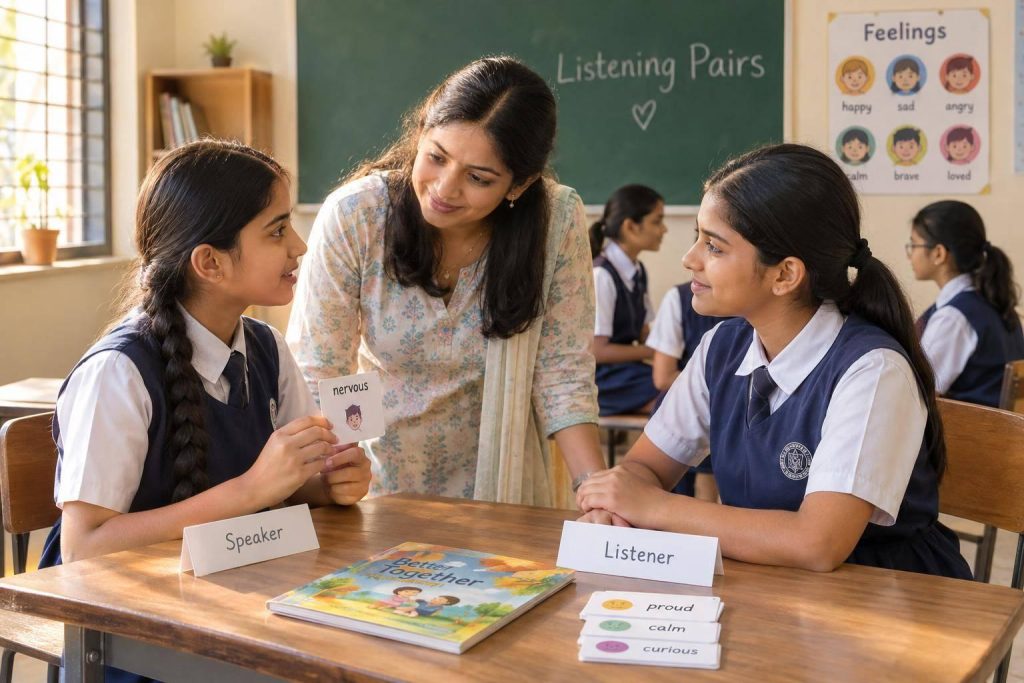
Teachers build empathy through daily practice – not by assuming girls are naturally caring. In CBSE girls’ classrooms, three routines help pupils understand feelings and respond with care:
- Discuss stories: Ask what a character might feel, why, and what could help.
- Practise paired listening: Have pupils listen, restate their partner’s point and check before responding.
- Use safe discussions and role-plays: Work with fictional situations, set clear rules and let pupils pass.
Younger pupils can name feelings and practise taking turns; older pupils can compare viewpoints and disagree respectfully. Keep personal experiences private, follow school procedures for concerns about harm, and track actions rather than label or rank pupils’ empathy.
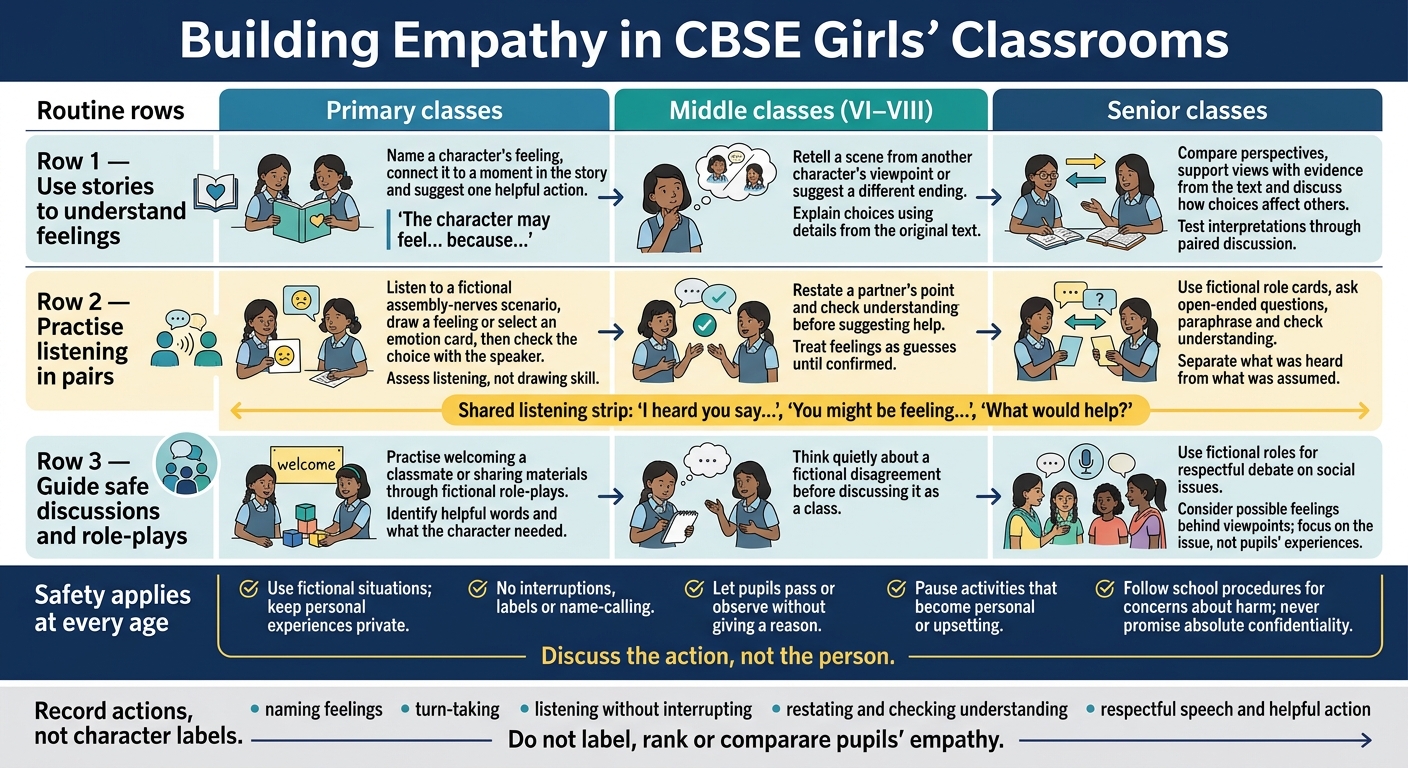
Building Empathy in CBSE Girls’ Classrooms
8 Activities to Teach Empathy, Emotions, and Perspective Taking
sbb-itb-9c83bad
1. Use Stories to Understand Feelings
Choose age-appropriate English or Hindi texts, including suitable Panchatantra or Jataka stories. Read each text beforehand and avoid stories that reinforce stereotypes. Look for characters who show compassion, honesty, a sense of justice and understanding.
After reading, give pupils a brief paired discussion to compare their reactions before sharing with the class.
Pause when a character faces rejection, a misunderstanding or a difficult choice. Ask pupils what the character might feel, which words support their view and what response might help. Accept different readings when the text supports them. Keep the discussion rooted in the story, linking each reading to how a character’s choices affect others.
Primary Classes: Name Feelings and Offer Help
Use expression cards with a simple sentence frame:
‘The character may feel… because…’
Ask pupils to connect the feeling to a specific moment in the story and suggest one helpful action.
Middle and Senior Classes: Consider Other Viewpoints
Ask pupils in Classes VI–VIII to retell a scene from another character’s point of view or suggest a different ending. Have them explain their choices using details from the original text. This gives them practice in speaking clearly and helps them see that more than one fair response can be valid.
For senior classes, choose texts that compare different experiences and perspectives while staying rooted in Indian values and a broader global outlook. Ask pupils to support their views with evidence from the text and discuss how a character’s choices affect others. Then use paired discussion to test their readings against another viewpoint.
2. Practise Listening in Pairs
Follow story discussion with short paired tasks that let pupils show how they listen. Ask one partner to speak and the other to listen, then swap roles. Rotate partners to help pupils feel comfortable, and offer teacher support at the start. Reinforce a simple rule: listen, check understanding and respond without judgement. Pupils should show that they understand before responding.
Model these sentence starters before pupils begin.
- I heard you say…
- You might be feeling…
- What would help?
Primary Classes: Listen, Draw, Check
Use a scenario about a pupil feeling nervous before an assembly.
Ask one partner to describe the situation while the listener draws a feeling or selects an emotion card. The listener then checks whether her choice matches what the speaker meant. Assess listening, not drawing skill: look for turn-taking, listening without interrupting and accepting corrections.
Middle and Senior Classes: Restate Before Responding
For Classes VI–VIII, ask pairs to discuss a scenario and a kind response. Before suggesting help, the listener must restate her partner’s point and check that she has understood it. Treat feelings as guesses until the speaker confirms them.
For senior classes, provide fictional role cards. Ask pupils to use open-ended questions, paraphrase answers and check their understanding. They should also separate what they heard from what they assumed. Assess listening behaviours, not personal disclosure.
3. Guide Safe Discussions and Role-Plays
After pairs practise listening, bring pupils together for a guided group discussion.
Set clear rules: no interruptions, labels or name-calling. Let pupils pass or observe without giving a reason. Use only fictional situations. Respect privacy, but report concerns about harm to an appropriate adult. Never promise absolute confidentiality, and pause any activity that becomes personal or upsetting.
Discuss the action, not the person. Stick to what the scenario shows rather than guessing about someone’s personal life. Use three prompts to guide pupils:
‘What happened?’, ‘What might the person feel?’ and ‘What respectful action could follow?’
These rules give pupils space to listen to feelings without fear or interruption. Short role-plays then help them put the rules into practice.
Primary Classes: Practise Kind Words and Actions
Use short, fictional role-plays about welcoming a classmate or sharing materials.
Afterwards, ask which words helped and what the character needed. Look for whether pupils link a possible feeling to a helpful action, rather than simply saying the character should “be kind”. This builds courteous speech and careful listening.
Middle and Senior Classes: Handle Disagreements Respectfully
In middle classes, give pupils time to think quietly about a fictional disagreement before discussing it as a class.
In senior classes, use fictional roles to practise respectful debate on social issues, such as choosing after Class 10 subject streams. Ask pupils to name possible feelings behind each viewpoint. Keep the focus on the issue, not any pupil’s personal experience, and make participation optional when a topic feels sensitive.
Conclusion: Build Empathy Through Daily Practice
Make these classroom routines part of each day. Practise the same habits across subjects to reinforce the school’s values.
Track Progress Without Ranking Empathy
Keep short observation notes on how pupils name feelings, listen, restate what they’ve heard before responding, speak respectfully and support one another. In younger classes, note turn-taking, courtesy and clear speech. In older classes, look for responsibility and helpful action.
Record actions, not character labels. Share brief notes with parents about observed behaviour, without comparing pupils.
FAQs
How can teachers support pupils who struggle to express feelings?
Teachers help pupils recognise their feelings and create a safe space where everyone feels welcome to talk openly. Activities and conversations give pupils room to share their thoughts and understand one another. Personalised guidance supports each pupil’s needs.
Through peer mentoring programmes, older pupils offer patient guidance. Pastoral staff and matrons provide steady care, helping every girl feel comfortable and supported when sharing her emotions.
How can empathy activities help address classroom bullying?
Empathy activities help tackle bullying by building mutual respect and understanding. Through peer mentoring, students learn to listen patiently and support classmates, helping reduce isolation and conflict.
Classroom discussions and group tasks give girls opportunities to practise active listening, solve problems and see situations from someone else’s point of view. When students understand how others feel, they’re less likely to bully and more likely to stand up for one another.
How can parents reinforce empathy at home?
Parents can help build empathy at home through emotional awareness and kindness. Encourage your daughter to talk openly about her feelings, and practise active listening during everyday conversations.
Take part in community service together to help her understand different perspectives and develop a sense of responsibility towards others. Stay in touch with her teachers and model respectful behaviour. These habits create a steady, supportive setting that backs up the school’s focus on compassion.