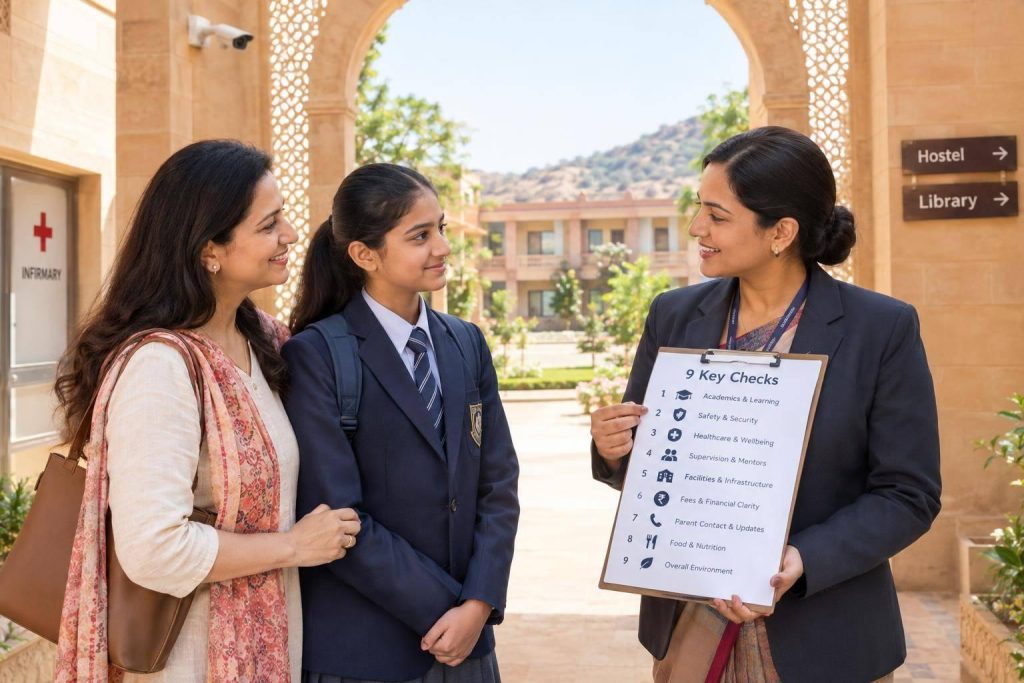
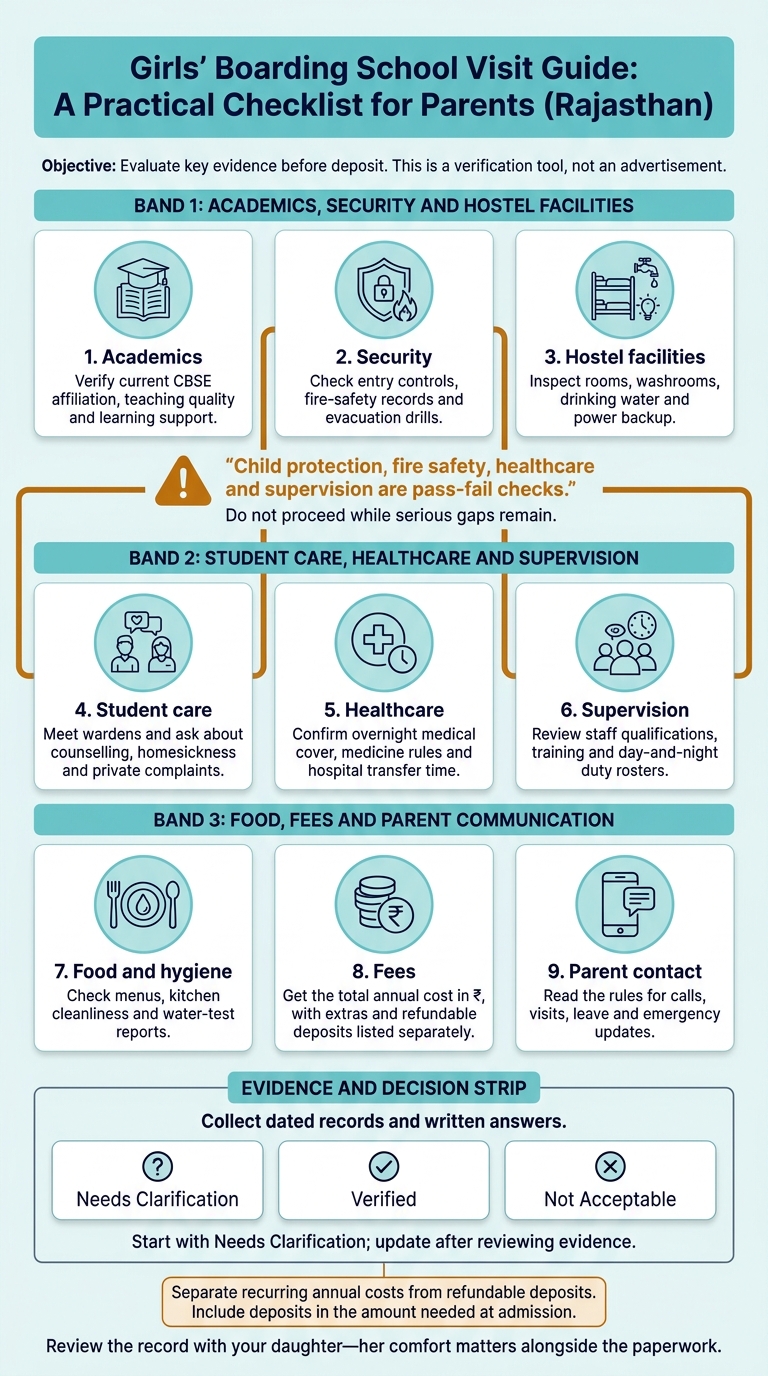
I’d check safety, daily care and the full annual cost before paying a boarding-school deposit. When visiting Dundlod Girls’ School – or comparing girls’ boarding schools in Rajasthan – I’d use these 9 checks:
- Academics: Verify current CBSE affiliation, teaching quality and learning support.
- Security: Check entry controls, fire-safety records and evacuation drills.
- Hostel facilities: Inspect rooms, washrooms, drinking water and power backup.
- Student care: Meet wardens and ask about counselling, homesickness and private complaints.
- Healthcare: Confirm overnight medical cover, medicine rules and hospital transfer time.
- Supervision: Review staff qualifications, training and day-and-night duty rosters.
- Food and hygiene: Check menus, kitchen cleanliness and water-test reports.
- Fees: Get the total annual cost in ₹, with extras and refundable deposits listed separately.
- Parent contact: Read the rules for calls, visits, leave and emergency updates.
My rule: <u>no deposit while serious gaps in child protection, fire safety, healthcare or supervision remain</u>. I’d collect dated records and written answers, then review them with my daughter – because her comfort matters alongside the paperwork.
Girls’ Boarding Schools in Rajasthan: 9 Essential Checks
Checks 1–3: Academics, Security and Hostel Facilities
1. Verify CBSE Affiliation and Teaching Quality
Check Dundlod Girls’ School’s affiliation number and validity against CBSE’s official records. Confirm with the academic coordinator that the school offers Classes II–XII, with Science, Commerce and Humanities streams at the senior secondary level. The school reports a 25:1 student–teacher ratio; ask what this means for actual class sizes.
Find out how assessments work and who supervises Evening Study Support. Observe a lesson and inspect the labs, classrooms and library. Ask how teachers identify learning gaps and track each student’s progress.
2. Check Campus Security and Fire Safety
Inspect the multiple-gate system, high perimeter fencing, biometric staff entry and 24/7 CCTV surveillance. Ask how visitors are verified and who monitors the footage. Check how student leave receives approval from the Principal, warden and verified parent/guardian.
Request current fire-safety records, evacuation plans and the register of periodic safety drills. Review the drill dates, outcomes and follow-up actions – not just whether a drill took place.
3. Inspect Hostel Facilities and Living Conditions
With permission, visit the dormitories, toilets, bathing facilities, study areas, recreation areas and laundry facilities. Verify that the dorms are centrally air-conditioned and that junior and senior students have separate arrangements. Check that each student has a separate bed, study table and lockable almirah.
Ask whether power backup supports air-conditioning during outages. Check bathroom water pressure and access to filtered drinking water, and find out how maintenance issues are reported and resolved.
Mark each item as verified or pending, noting the staff member responsible and a follow-up date.
sbb-itb-9c83bad
Inside Dundlod Girls’ School, Rajasthan | Premier CBSE Boarding & Day School 🏫✨
Checks 4–6: Student Care, Healthcare and Supervision
After checking rooms and security, look at daily care, healthcare and supervision.
4. Review Pastoral Care and Child Protection
Matrons and female wardens manage daily routines and care. Ask whether the school has a designated counsellor, counselling support and regular student check-ins. Meet your daughter’s matron, warden and counselling contact. Find out how they help students with homesickness and other everyday concerns.
Request the boarding handbook, the school’s student and staff safety policy, and its complaint procedure.
5. Verify Healthcare and Emergency Response
Check how the school responds when a student falls ill or needs emergency care.
Look for an on-site infirmary with a doctor and nurses on duty 24/7, dedicated isolation rooms and medical check-ups at the start of each term. Confirm who stays on campus overnight and who provides first-aid cover. Ask for the referral hospital’s name, its distance in km and the expected transfer time.
Review the written procedures for storing and administering medicines, managing allergies and supporting menstrual health.
6. Check Staff Qualifications and Supervision
Review the qualifications of matrons, wardens, nurses and coaches. Check that residential staff have current first-aid and child-protection training. Ask to see day and night duty rosters, staff-to-student ratios and overnight supervision arrangements for each age group.
Checks 7–9: Food, Fees and Parent Communication
Once you’ve checked safety and supervision, look at the food, fees and family contact that shape daily boarding life.
7. Check Food, Drinking Water and Hygiene
Ask to see the current mess menu and the nutritionist’s qualifications. Confirm that vegetarian meals and regional food preferences are catered for.
Inspect the kitchen, dining hall and drinking-water points. Request recent water-test reports, purifier maintenance logs, food-safety records, pest-control logs and cleaning schedules. Ask how students submit food-related complaints or suggestions, and how the school records and resolves them.
8. Calculate the Total Annual Cost
Get an itemised fee statement covering registration, admission, tuition, hostel, mess and security deposit charges. It should also list extra charges for uniforms, books, stationery, transport, activities, trips, medical care, Wi-Fi, laundry, housekeeping and evening study support. Mark each charge as compulsory, optional, refundable or usage-based.
Add travel to and from school and personal expenses to calculate your total in ₹. Keep refundable deposits separate from recurring costs, but include them in the amount you’ll need at admission.
Before paying, check payment dates, late fees, withdrawal rules and refund conditions. Also confirm whether the school can revise fees during the session.
9. Review Parent Communication and Visiting Rules
Check how the school keeps parents informed and handles visits and leave.
Review the parent handbook and communication calendar for parent-teacher meeting dates, regular progress updates, official emergency channels and visiting rules. Ask how the school reports illness, injury or behavioural concerns.
Read the visit and leave rules carefully. Confirm when permission is needed from the principal, warden or parent/guardian. Your daughter should also know how to report a concern privately – through approachable staff, trained matrons, a private complaint route or a student reporting channel.
Conclusion: Complete Your 9-Check Visit Record
After the visit, transfer your notes into this record so you can compare schools on the same terms. Mark each check as Needs Clarification, then update it to Verified or Not Acceptable.
| Check | Evidence seen | Documents verified | Open questions | Annual cost (₹) | Parent decision |
|---|---|---|---|---|---|
| 1. Academics | Classrooms and labs | CBSE affiliation; staff qualifications | Is the affiliation current? | Tuition | |
| 2. Security and fire safety | Exits; access controls; CCTV; fencing | Fire safety certificate; drill records | When was the last drill? | N/A | |
| 3. Hostel facilities | Rooms and washrooms | Hostel manual | How are rooms allotted? | Hostel fee | |
| 4. Pastoral care | Interaction with the matron | Child protection policy | Is a counsellor available? | N/A | |
| 5. Healthcare | Infirmary | Medical SOPs; check-up logs | How far is the hospital? | N/A | |
| 6. Staff qualifications and supervision | Duty arrangements | Qualifications; background checks; rosters | Who supervises pupils at night? | N/A | |
| 7. Food, drinking water and hygiene | Dining conditions | Water reports; hygiene records | When was the water last tested? | Boarding fee | |
| 8. Total annual cost | Written quotation | Dated fee schedule | Are any charges missing a price? | Annual total; deposits separately | |
| 9. Parent communication and visiting rules | Named contacts | Calling and visiting policy | How often are calls allowed? | N/A |
Child protection, fire safety, healthcare and supervision are pass-fail checks. Do not proceed while serious gaps remain. Ask for written clarification against current CBSE and residential-school norms, with NCPCR child-protection guidance as the benchmark. Also request any hostel self-assessment or audit report.
Before paying a non-refundable deposit, collect written answers, dated policies and fee estimates. Review the record with your daughter, noting both your concerns and hers.
FAQs
How can I tell if my daughter is ready for boarding school?
Look for signs that she’s becoming more independent – socially, emotionally and in everyday tasks. Can she manage her hygiene and organise her belongings without constant supervision? Notice how she settles into new surroundings, interacts with peers and confidently tells adults what she needs.
Readiness also means showing more interest in structured activities and sports. It includes the emotional maturity to handle time away from home and trust the care and support available at school.
What should I do if safety records are unavailable?
If safety records are missing or unclear, ask the school administration for copies of the mandatory safety documents. Check that the building safety certification meets the National Building Code and that the fire safety certificate is valid and issued by the competent authority.
Request written safety policies for students and staff, and ask about the school’s security procedures. Tour the campus to check CCTV surveillance, access controls and security staffing.
How can I assess hostel care beyond a school tour?
Review the school’s safety and student welfare policies, including pastoral care, medical support and procedures for communication between staff and parents. Check mandatory public disclosures, such as building and fire safety certificates, to see how openly the school shares this information.
Ask school management about supervision ratios, training for matrons and wardens, and personal counselling arrangements. These details can help you understand how the school supports students and creates a home-like setting.